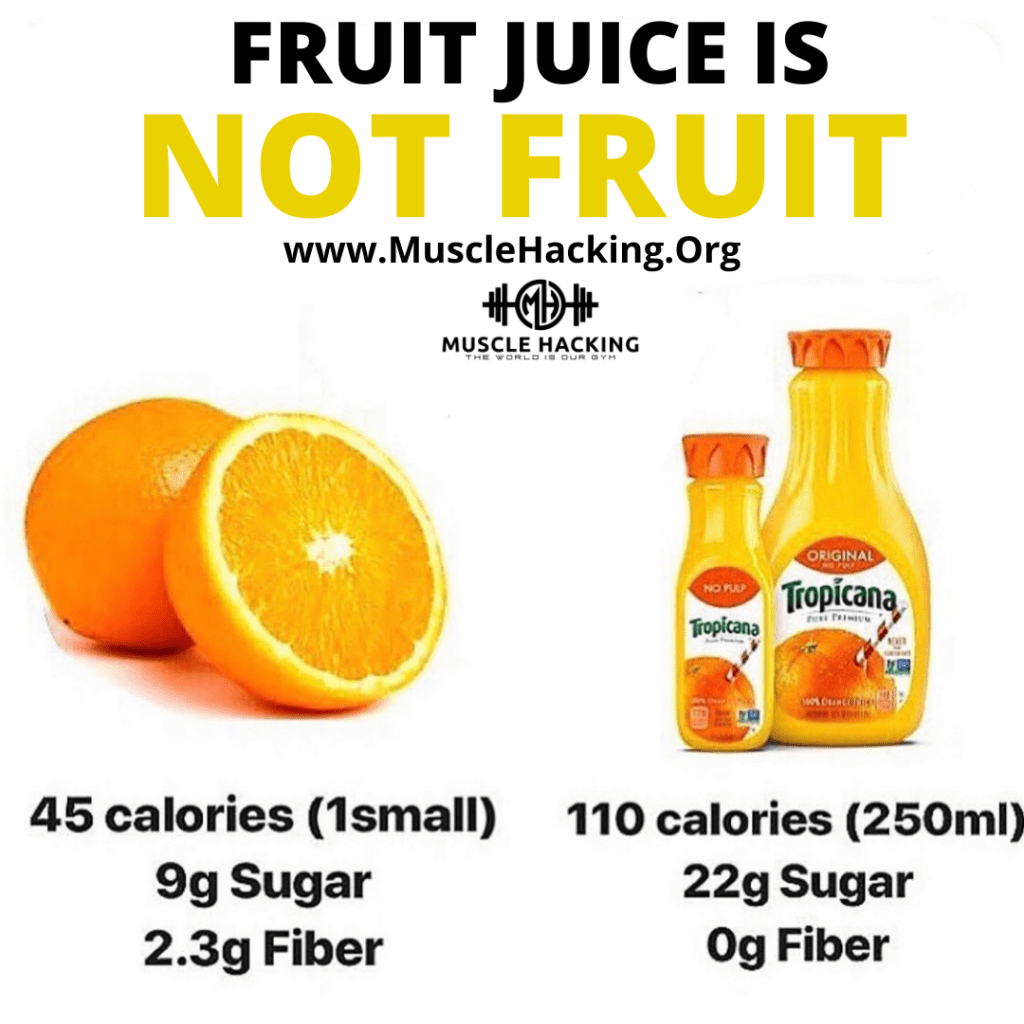
Fruit Juice Is Not Fruit

Have you ever considered the total amount of teaspoons of sugar in a bottle of fruit juice?

Many family households consume litres of fruit juice a week, unaware the volume of sugar inside.

Cheaper concentrated juices have heaps of additional sugar added.
Why?

To make the product taste more appealing and reduce the cost compared to 100% freshly squeezed fruit juice.

It’s common to pop into a supermarket and pick up a Meal deal with a bottle of fruit juice included.
(Average bottle between 250-500ml)

100% organic freshly squeezed orange juice…. sounds like a good choice but little do many know it will have anyware from 22 – 44g of sugar per bottle.
This is equal to 5.5 – 11 teaspoons of sugar!

This isn’t directly unhealthy, and of course this can be enjoyed alongside a balanced diet.

One drink can be the equivalent of adding 11 teaspoons of sugar to a cup of coffee or tea. You wouldn’t let your children add 11 teaspoons of sugar to a cup of tea, but it’s common to give children the equal amount of sugar, disguised as “Liquid Fruit?”

Some make the mistake of swapping coke for fruit juice as a “healthy” alternative when aiming to lose weight, without being aware that the fruit juice can contain more calories than the coke.

Liquid calories add up, if you’re looking to lose weight, be conscious of what you consume.
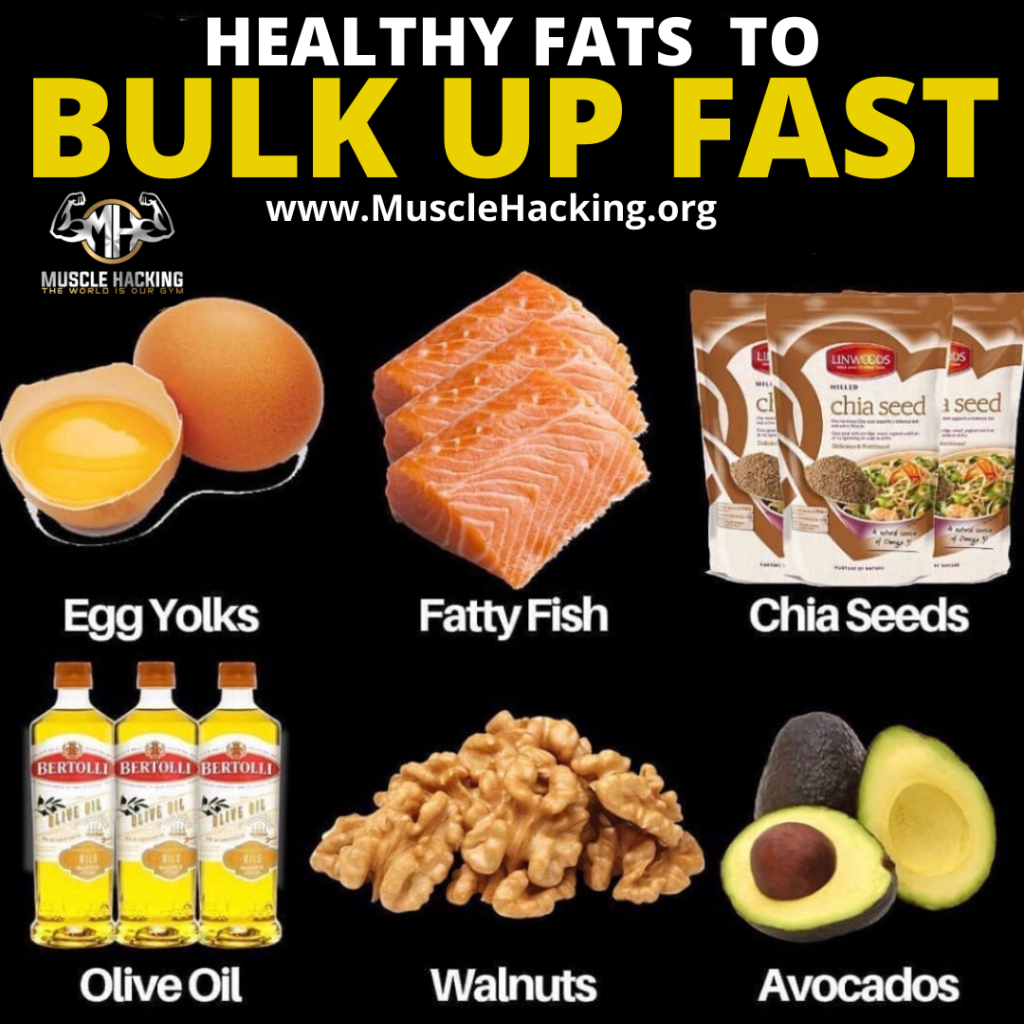
Healthy Fats

You can be quite flexible in how you reach your fat intake for the day—but, I recommend you get most of your dietary fats from healthy choices like: meats, eggs, nuts, seeds, oils, and fatty fish.
.
Although I wouldn’t overthink your saturated fatty acid consumption, I do suggest that you strive to get plenty of your daily fat intake from unsaturated fats.
.
Ultimately, if you’re reaching your minimum required fat intake for the day (0.4g / pound of BW)—while making an effort to get a good deal of it from healthy fat sources—you’ll surely achieve all of the health and performance benefits that come from a healthy fat intake.

Macro Nutrition

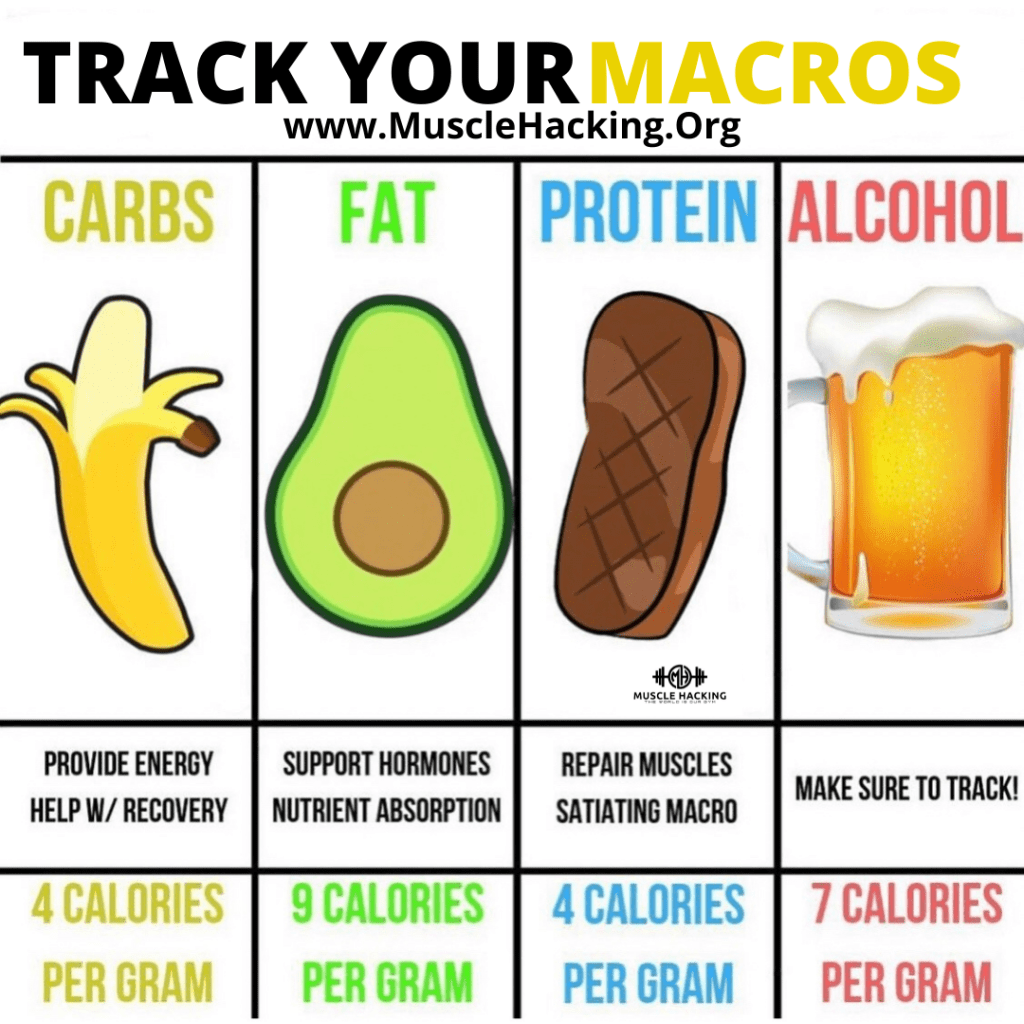
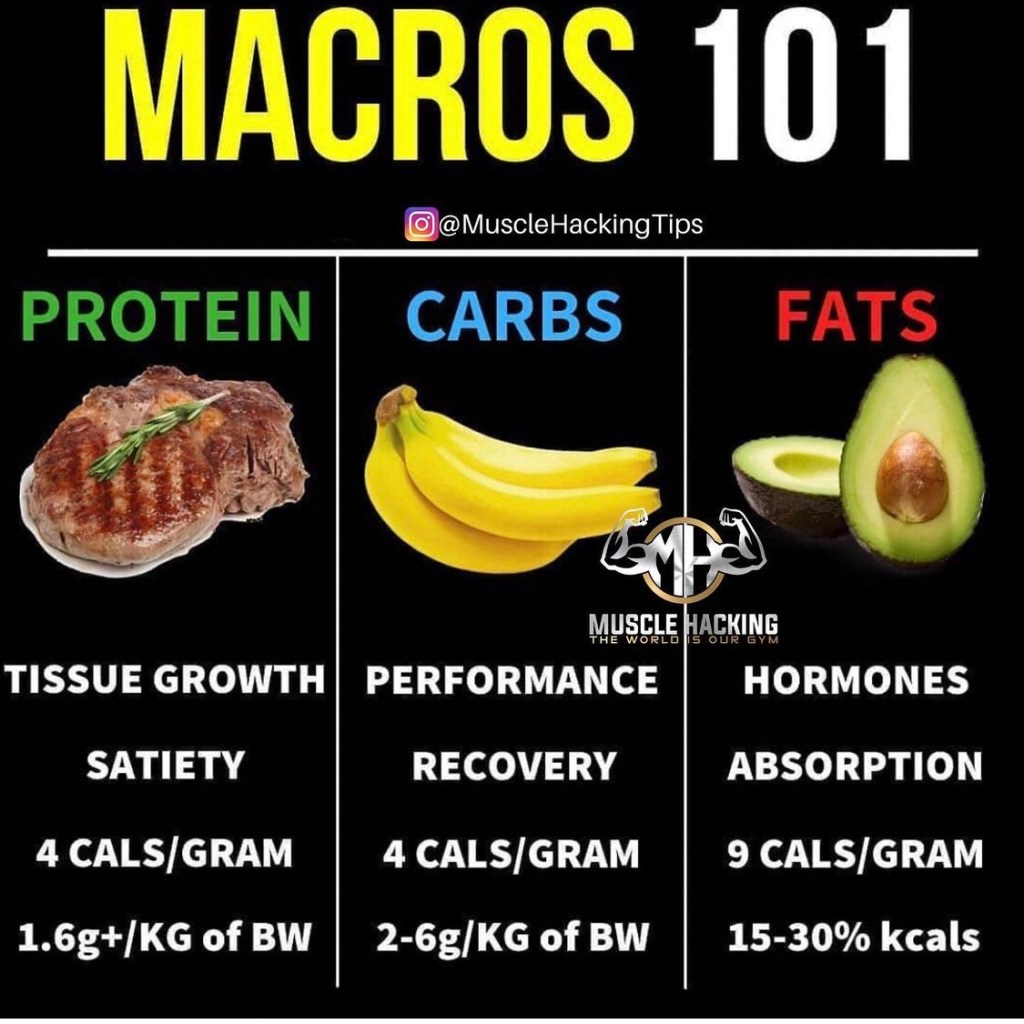
If you want to properly track your calories and macros, you need to get a sense of the caloric content of each macro.

Carbs help provide us with energy, and have 4 calories per gram, so if you eat 250g of carbs a day, that contributes 1,000 total calories.

Fats help support hormones, and have 9 calories per gram. Fat is the most calorically dense macro, and can be more filling. If you eat 80g fat everyday, that contributes to 720 calories.

Protein helps repair the muscles after we workout, and has 4 calories per gram. If you eat 150g protein everyday, that contributes to 600 calories.

DON”T FORGET ABOUT ALCOHOL EITHER. Alcohol, in some ways, can be considered a 4th macro. It contains 7 calories per gram. So if you have 2 drinks (those 2 drinks in this example being 2 1.5 oz shots of vodka), that can come out to around 190 calories. Calories from alcohol can be very sneaky, so make sure to keep that in mind!

So let’s put all those numbers together: From the examples above, let’s say one person one day eats 250g carbs, 80g fat and 150g protein. All that combined comes out to 2,320 calories. 1,000 calories coming from carbs (250g x 4 calories/g), 720 calories coming from fat (80g x 9 calories/g), and 600 calories coming from protein (150g x 4 calories/g).

Hope this helps if you’re struggling with macro tracking!

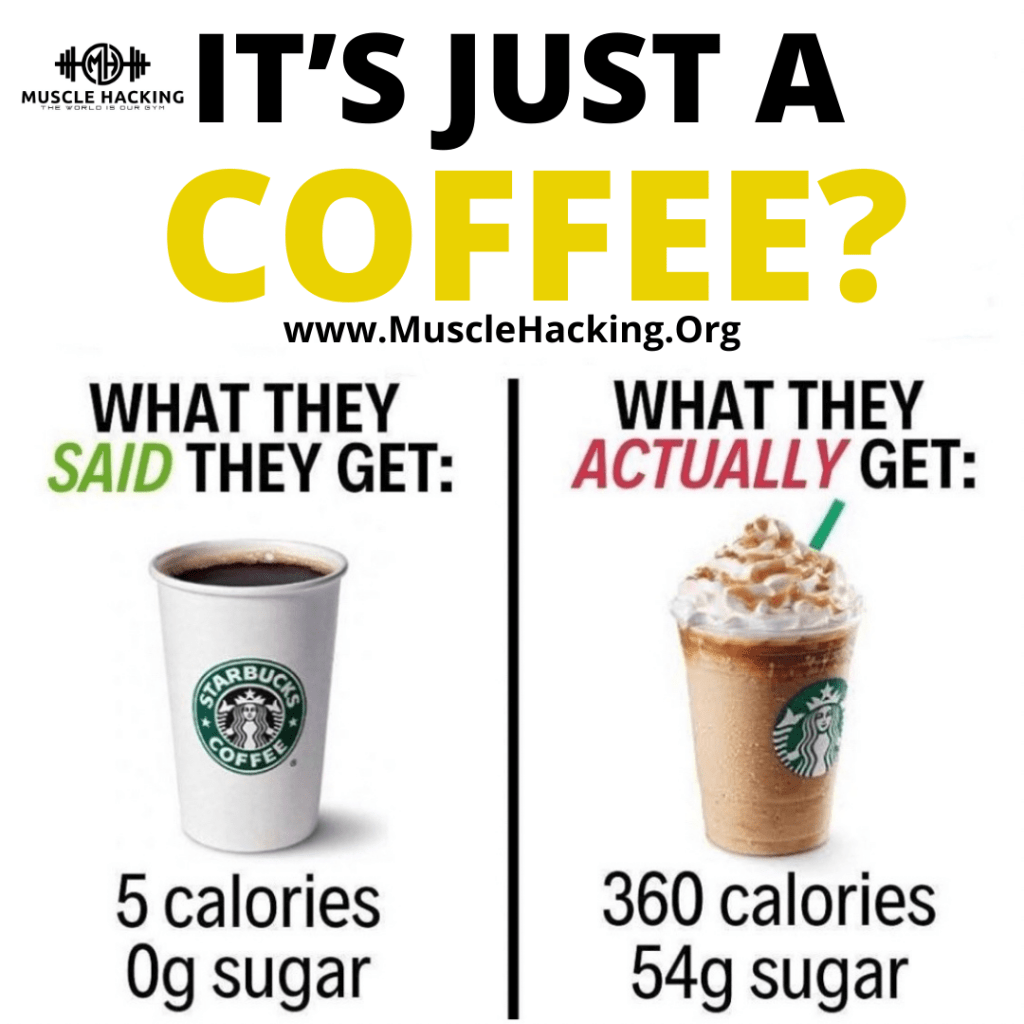
The Type of Coffee That You’re Drinking Could Be The Problem ⠀⠀⠀⠀⠀⠀⠀⠀

The majority of people don’t think twice about regularly drinking coffee packed with 200, 300, even 400 kcals per beverage…⠀⠀⠀⠀⠀⠀⠀⠀⠀
⠀⠀⠀⠀⠀⠀⠀⠀⠀⠀
Yet, when it comes to eating 300-400 kcals worth of nutrient-dense, quality foods….they are “too much”.⠀⠀⠀⠀⠀⠀⠀⠀⠀
⠀⠀⠀⠀⠀⠀⠀⠀⠀⠀
I’ve seen it happen over and over again with new clients…⠀⠀⠀⠀⠀⠀⠀⠀⠀
⠀⠀⠀⠀⠀⠀⠀⠀⠀⠀
These types of habits truly can be enough to stall your weight loss efforts.⠀⠀⠀⠀⠀⠀⠀⠀⠀
⠀⠀⠀⠀⠀⠀⠀⠀⠀⠀
Consuming 300 extra calories every morning might seem small, but added up 7-days per week, 30 days per month….and we’re talking about potentially 10,000+ additional calories in A MONTH!⠀⠀⠀⠀⠀⠀⠀⠀⠀
⠀⠀⠀⠀⠀⠀⠀⠀⠀⠀
Big takeaway here…
⠀⠀⠀⠀⠀⠀⠀⠀⠀⠀
If you drink high-calorie coffee, or any liquid calories in excess (soda, juice, alcohol, etc.), you just might need to reassess your daily habits before you claim that “you can’t lose weight”!⠀⠀⠀⠀⠀⠀⠀⠀⠀
⠀⠀⠀⠀⠀⠀⠀⠀⠀⠀
Tag a friend that would find this beneficial!⠀

How To Gain Muscle

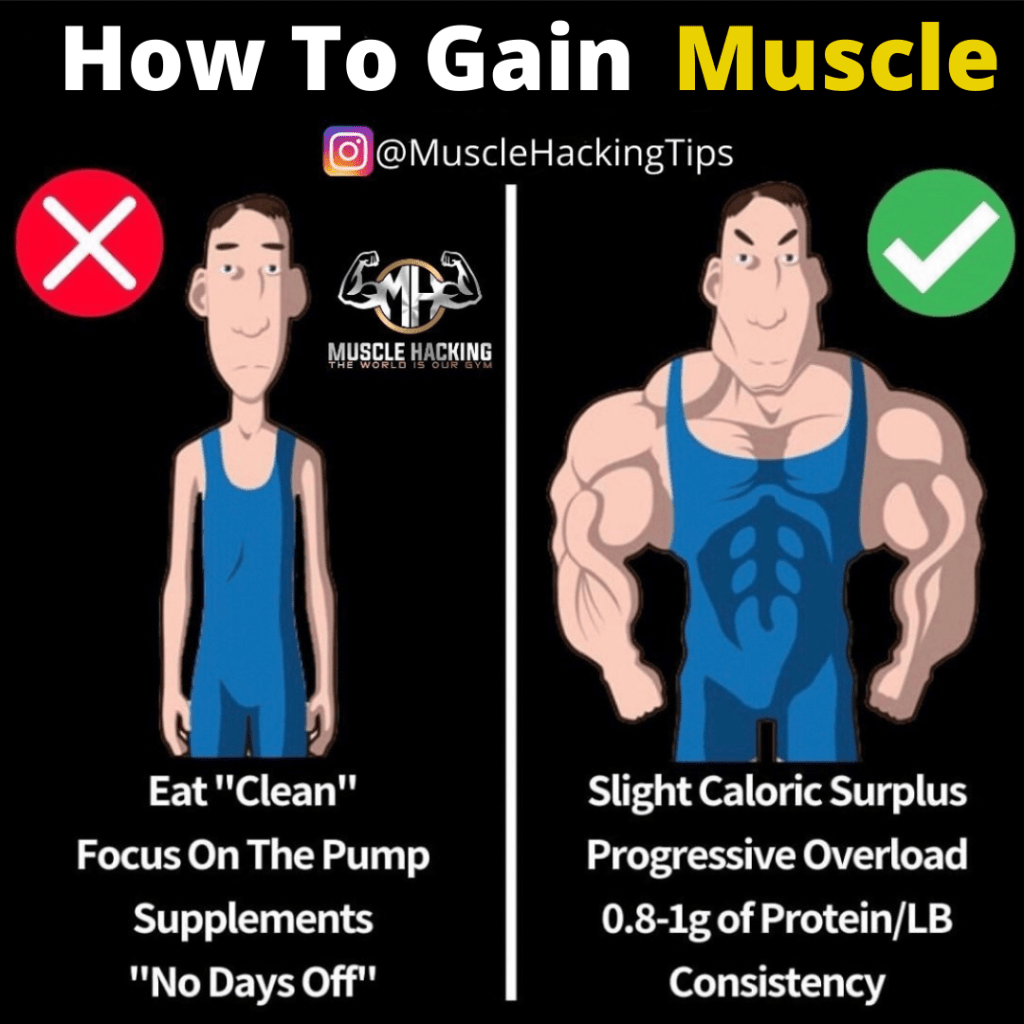
Want to know the secret to unlimited muscle growth? The secret is this: there is no secret. Eat enough, train for progression, and do it consistently. Perhaps that’s a bit of an oversimplification, don’t you think? The truth is, though, the mechanisms by which we build muscle are quite simple. There are three main factors that dictate muscle growth, and if you act in accordance to the three principles, you’re guaranteed to grow, despite “good” or “bad” genetics. ⠀⠀⠀⠀⠀⠀⠀⠀⠀
_ ⠀⠀⠀⠀⠀⠀⠀⠀⠀

  1. First, we must be in a net positive energy balance to ensure we’re providing our body the necessary nutrients for growth. This simply means that we should be consuming more calories than we’re burning (with the caveat that we’re getting enough protein – 0.8-1g/ pound will suffice).⠀⠀⠀⠀⠀⠀⠀⠀⠀
    _⠀⠀⠀⠀⠀⠀⠀⠀⠀
  2. Progressive tension overload: When we introduce a stress to our muscle, our body is forced to adapt by building new muscle in the hopes that it will handle the same stress again in the future. If we fail to increase that stress, however, our body will find no need to repair and grow. It’s really that cut and dry. ⠀⠀⠀⠀⠀⠀⠀⠀⠀
    _ ⠀⠀⠀⠀⠀⠀⠀⠀⠀
  3. Consistency: If you’re “eating enough” five days out of seven, you’re not eating enough. That one or two days of skipping meals, missing calories, or eating intuitively, could determine whether you make any progress that week. Similarly, missing training days will reduce the amount of work you’ll have done in a given timeframe.⠀⠀⠀⠀⠀⠀⠀⠀⠀

Leg Day

A Lot of times people try to skip leg-day or get it over with as quickly as they can, by ignoring big parts of their legs, mainly because they think it’s too boring to train something that isn’t as “visual” as the upper body.⠀

If you’re reading this, 9 times out of 10 you’re a Muscle Hacker so don’t go this route. If you’re training for visuals, you want your legs to match your upper body, or you’ll end up as a chicken-legger. Do you really want to go your whole life being called, “ chicken legs”, at the gym?

Yea I didn’t think so…

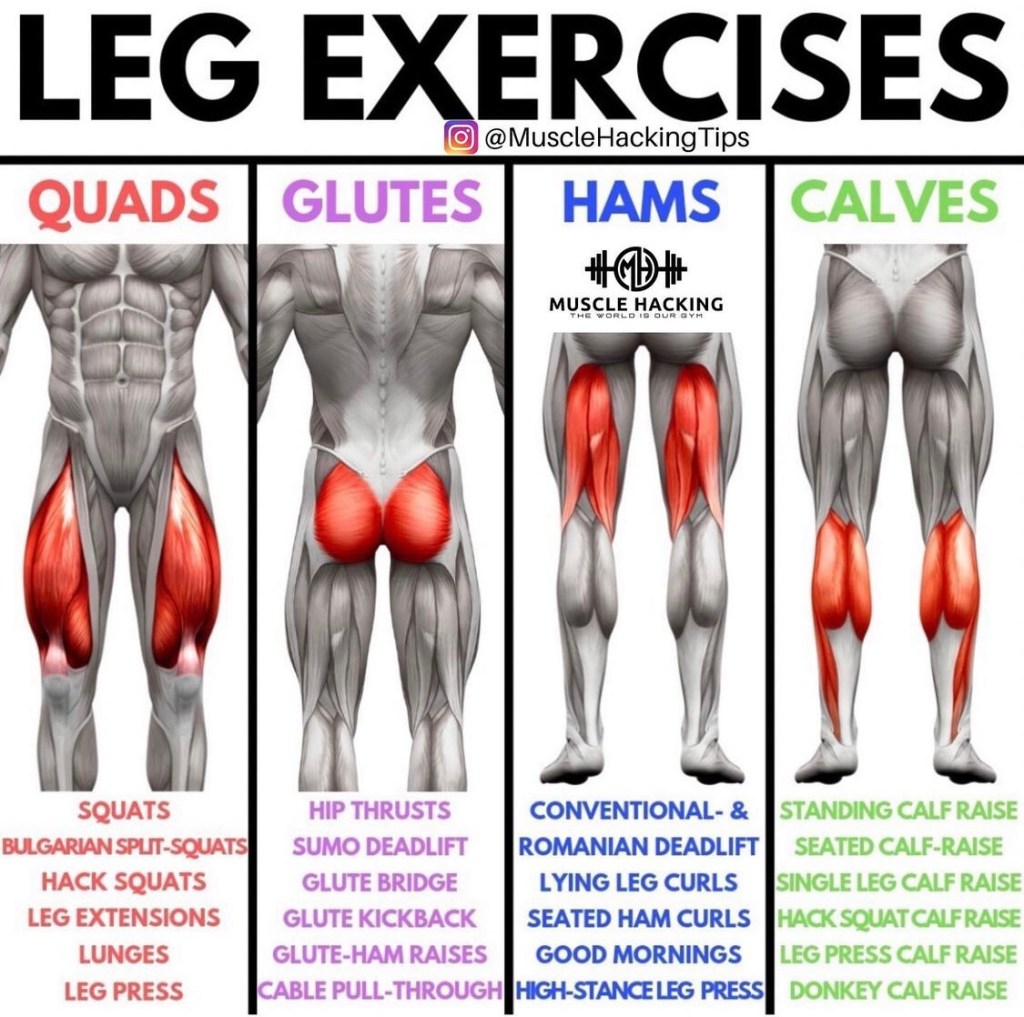
And to get a well-rounded leg physique, you don’t want to jump onto your quadriceps exercises only, which happens to some people. Below is a guide for you to create a big and strong lower body!⠀

So, to get a well-rounded leg day, aim for 1-2 exercises per muscle group of the 4 above. If you’re training for muscle growth, you can aim for 2-6 sets per exercise and 6-15 reps.⠀

For Strength, you can go for 2-6 sets per exercise and 2-6 reps.⠀

Remember, you want to keep progressively overload by, for example, increasing the weight or adding reps.⠀

When, you ask?⠀

A good guide is, if you’re doing 3 sets of 10 reps; and on your last set, you can perform 12 reps, then you can increase the weight by 2-10%.⠀

What is your favorite leg exercise? Comment below!

Macro Nutrition

Protein: When you consume protein, your body breaks down the protein molecules into amino acids and uses them to build new muscle. If you don’t consume enough protein, however, your body may not get enough of these amino acids, thus impairing your ability to build and repair muscle tissue.
.
The average sedentary person can “survive” with very little protein due to a survival mechanism we inherited from our ancestors. This mechanism allows us to recycle broken down protein. Although you would die if you didn’t consume protein, you can easily survive on miniscule amounts.But, you’re not average and sedentary, right? Since you’ll be regularly lifting weights, your body will require more protein. In fact, research has shown that athletes need to eat a high protein diet to maximize performance.
.
Fats: Dietary fat is the most calorically dense energy source available to your body. Each gram of fat contains twice as many calories as a gram of carbohydrates or protein. Good fats are found in dairy, meat, eggs, oils, nuts, and fish. These fats aid in your body’s ability to absorb nutrients.
.
Carbohydrates: A study published in The American Journal of Clinical Nutrition found that when subjects were put in a 50% caloric surplus—either purely from carbs or purely from fats—after one day of overfeeding, the carb-only group stored just 10% of excess calories as fat, while the fat-only group stored a whopping 60%. In short, excess dietary fat leads to greater fat accumulation than does excess dietary carbohydrates.
.
This actually makes perfect sense, especially since there is plenty of evidence that carbs are inefficiently stored as body fat even when overfeeding—this is due to a highly regulated metabolic pathway known as de novo lipogenesis.
.
Carbohydrates are sugars, starches and fibers found in fruits, grains, vegetables and milk products. Their main responsibility revolves around energy. This energy comes from a sugar called glucose. So, whether you are consuming carbs from candy or from brown rice, the carbs are converted to glucose during digestion, which then becomes the preferred energy source for both the mind and muscles.

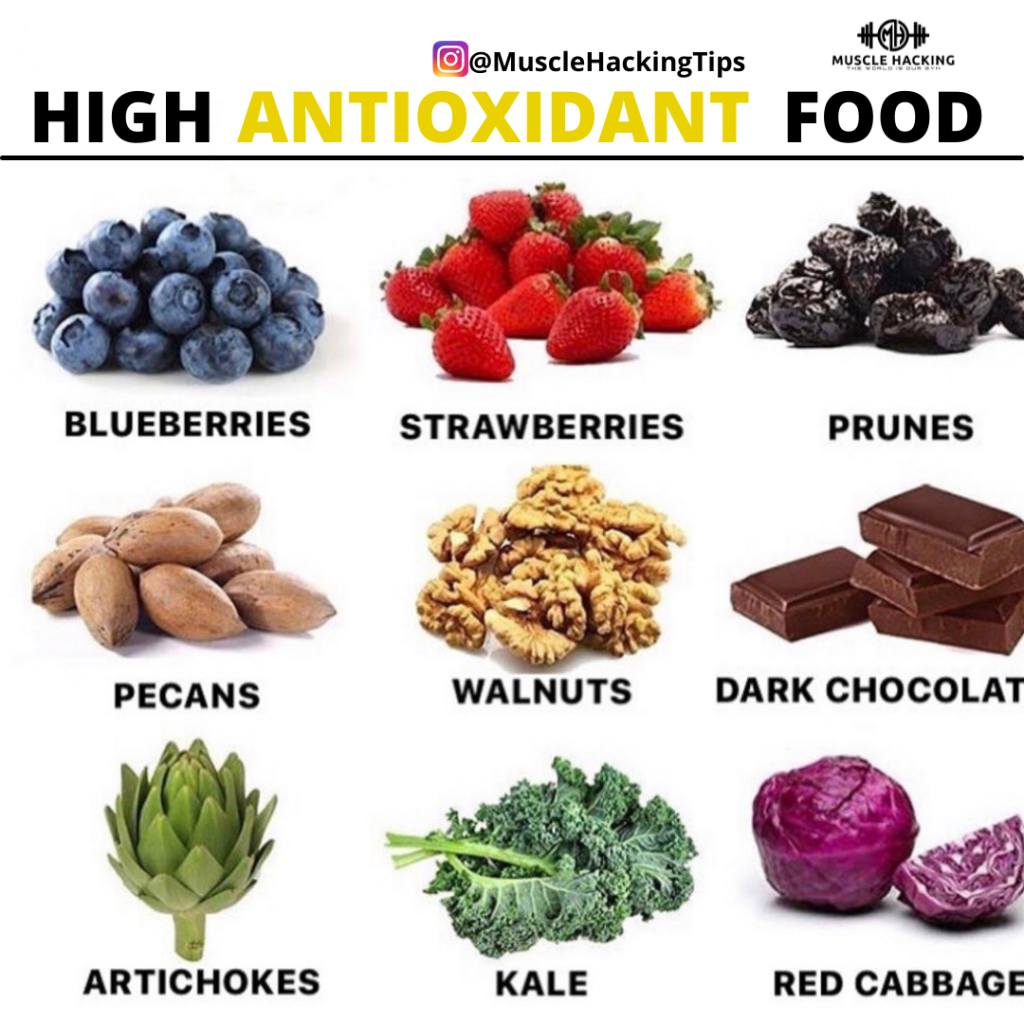
High Antioxidant Foods

Why are antioxidants important?

🔹 Antioxidants are compounds produced in your body and found in foods. They help defend your cells from damage caused by potentially harmful molecules known as free radicals.

🔹 When free radicals accumulate, they may cause a state known as oxidative stress. This may damage your DNA and other important structures in your cells.

🔹 Sadly, chronic oxidative stress can increase your risk of chronic diseases such as heart disease, type 2 diabetes and cancer.

🔹 Fortunately, eating a diet rich in antioxidants can help increase your blood antioxidant levels to fight oxidative stress and reduce the risk of these diseases.

🔹 Scientists use several tests to measure the antioxidant content of foods.

🔹 One of the best tests is the FRAP (ferric reducing ability of plasma) analysis. It measures the antioxidant content of foods by how well they can neutralize a specific free radical.

🔹 The higher the FRAP value, the more antioxidants the food contains.

Recovery

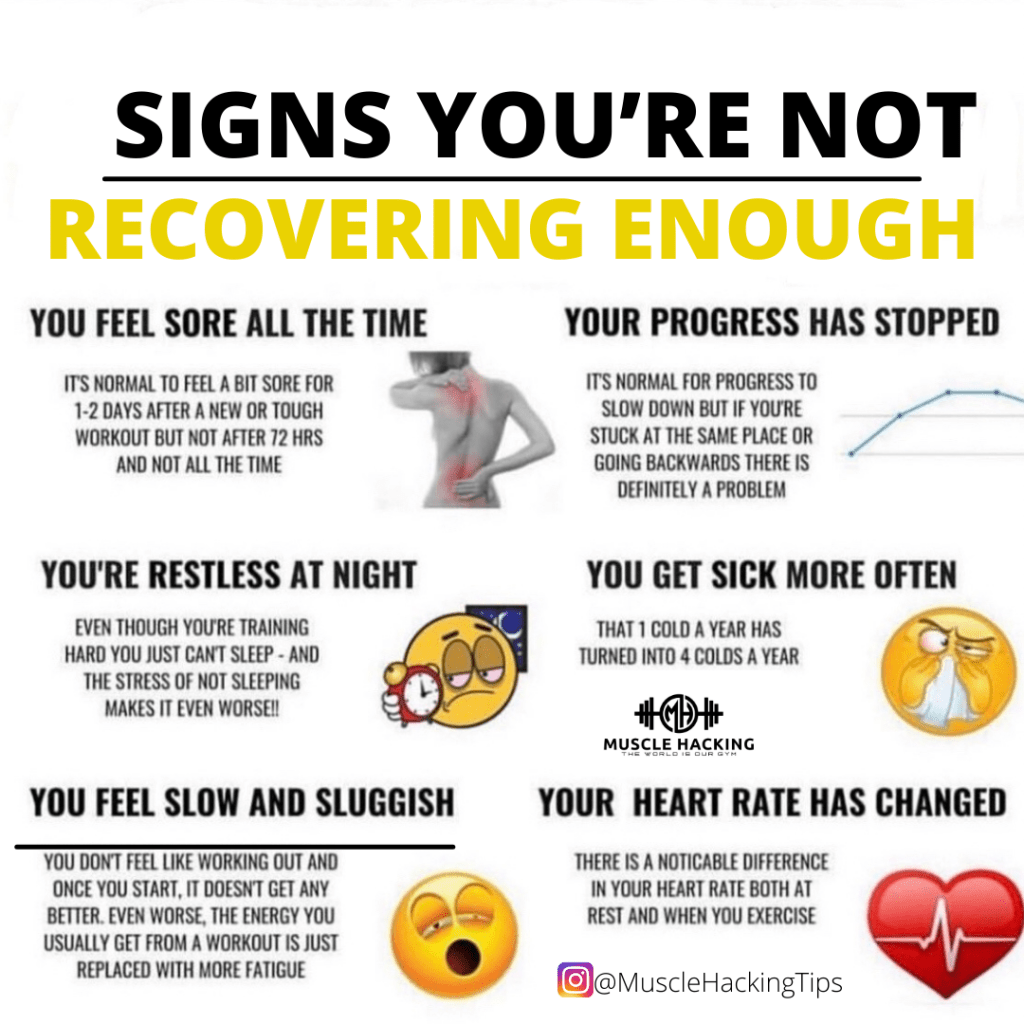
🔹 What is “enough” – no, this is not an existential question that people have been trying to figure out for centuries. It is, however related to a person’s capacity to recover and the amount of training they actually do.
.
🔹 A professional athlete trains like a professional athlete. Lots of training, lots of sleep, lots of good food and lots of therapeutic activities. An average person who starts training like a pro but falls short on the recovery part, is doomed to fail
.
🔹 Over training is a term that gets thrown around a lot. What it is, is simply too much training and not enough recovery
.
🔹 Other problems can arise from a lack of recovery like hormonal issues and injuries etc. Your body needs time to adapt and get stronger.
.
🔹 If you are experiencing any of the symptoms above, take a look at your training volume compared to the amount of time you sleep and how much you eat. You don’t want to be putting in all of that work for nothing!

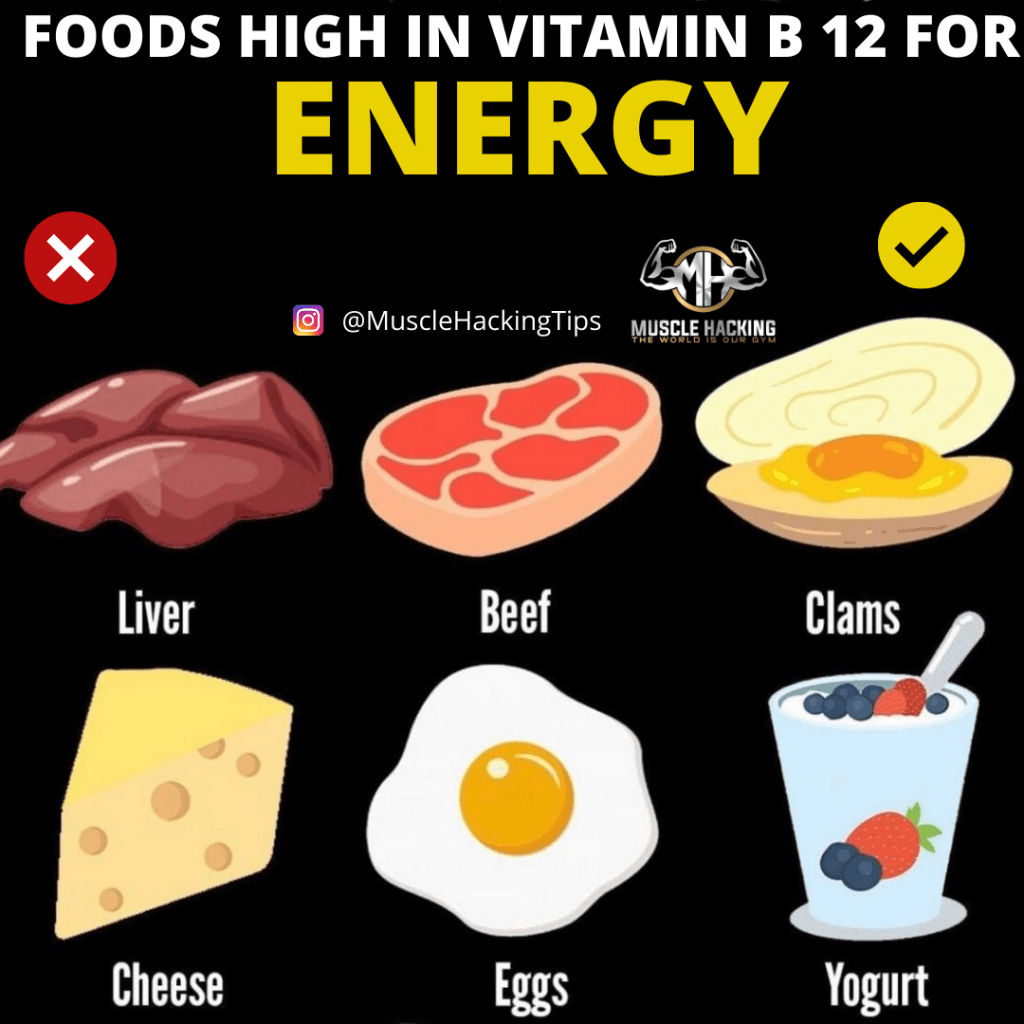
Vitamin B 12 For Energy

🔹 Vitamin B12 will benefit your body in various ways, such as by boosting your energy, improving your memory and helping prevent heart disease.

🔹 B12 has many roles in your body. It supports the normal function of your nerve cells and is needed for red blood cell formation and DNA synthesis.

🔹 40 % of the of the population has a deficiency in B12, which causes an extreme case of lethargy

🔹 If you are tired all of the time try consuming more B12 from natural food sources