Losing Weight Too Fast

♠️The Truth Behind Rapid Fat Loss♠️

▪️Energy balance is the prime element to lose weight; it’s essential that your expenditure exceeds energy intake.

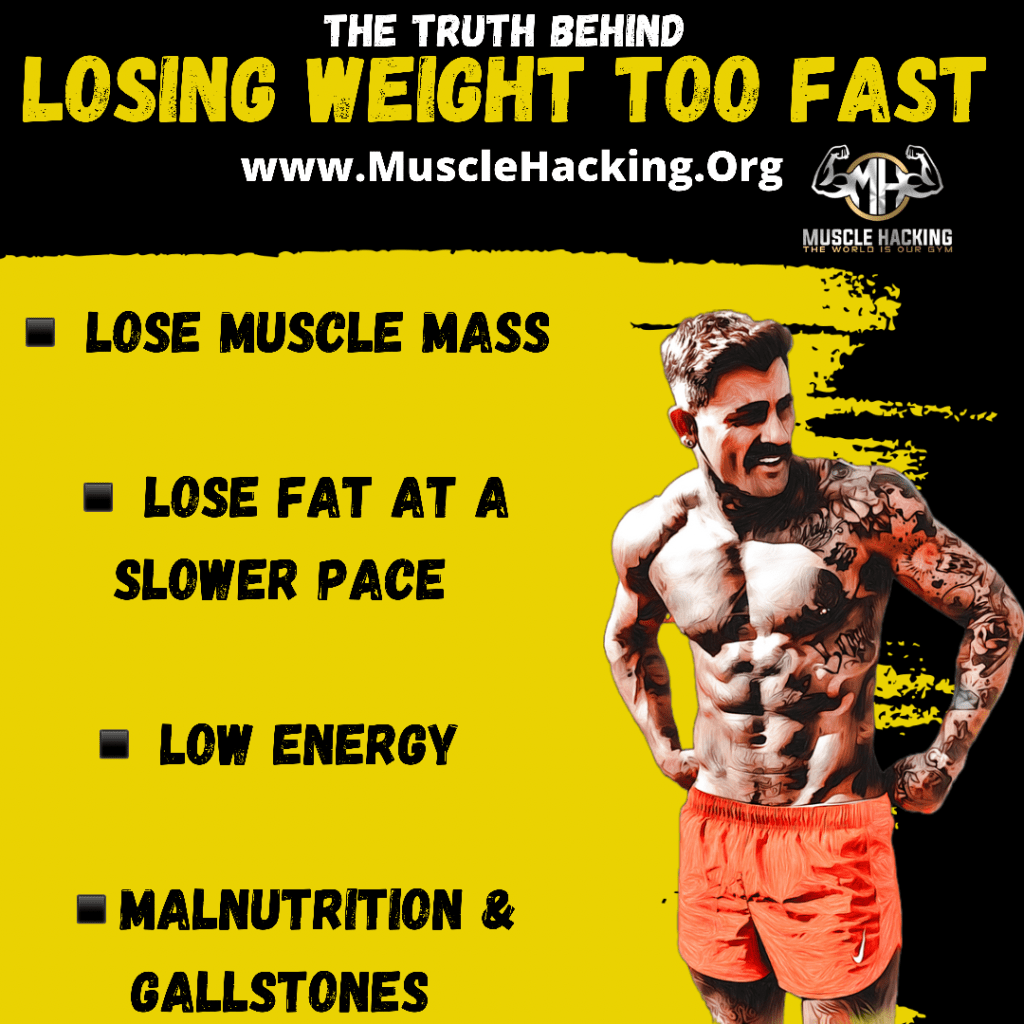
▪️Although aggressively dieting can increase fat loss, it will also reduce muscle mass. This sparks the question if losing weight as fast as humanly possible is the most optimal strategy.

▪️A case study inspected the effect of two different rates of weight loss on body composition. One group lost weight rather quickly (1% of bodyweight per week), while the other group lost weight at a  more slower pace (0.7% bodyweight per week).

▪️After 5.3 weeks, the aggressive dieting group lost 4.2 kg or 9.2lbs of bodyweight. On the other hand, the slower dieting group took 8.5 weeks to lose this amount.

▪️Even though both groups lost an equal amount of weight, the body composition of the lost weight was different. The aggressively dieting group lost more muscle mass  and less fat in comparison to the slower dieting group. 

▪️Therefore, this study concludes that more aggressive weight loss goes at the expense of losing muscle gains.

▪️So technically aggressive dieting is effective for rapid weight loss, but suboptimal if you want to keep the muscles that you worked hard for.

▪️Resources: https://pubmed.ncbi.nlm.nih.gov/21558571/
Post Workout Carbs

♠️Carbs After Workouts♠️

🔹 It’s often said that carbs are important for post-workout recovery. At times people even claim that carbs are more important than protein. Is this actually the case?

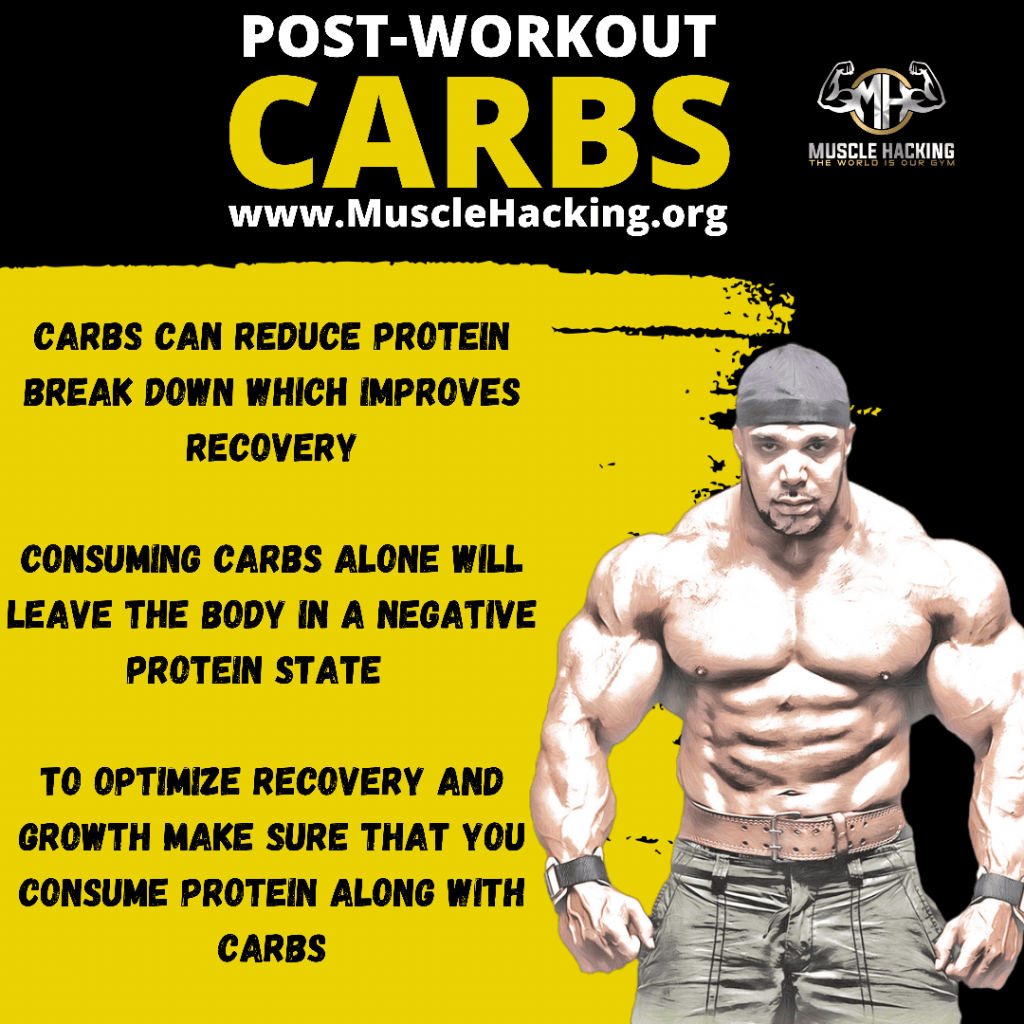
🔹 When we perform any type of strength training, we inevitably break down some muscle tissue. If we train in a fasted state, it’s very likely that by the end of the workout we will be in a negative protein balance. This is because we’re breaking down more muscle than we’re building. If I made the assumption that carbs were more important than protein and only consumed carbs after my workout, I would be in a negative protein balance. If I’m in a negative protein balance, my muscles wouldn’t grow.

🔹So how can we fix this situation? If your goal is to grow muscle, make sure that you are getting enough protein after your workouts;especially if you are training while fasted. The goal should be to spend as much time as possible in a positive protein balance and getting protein ASAP after working out is a great way to ensure this happens.

🔹 Message me the word “FREEDOM” for consultation to improve your nutrition regimen to MuscleHackingInc@gmail.com

Resources: https://www.ncbi.nlm.nih.gov/pmc/articles/PMC5794245/

How To Show Your Veins

How To Show Your Veins

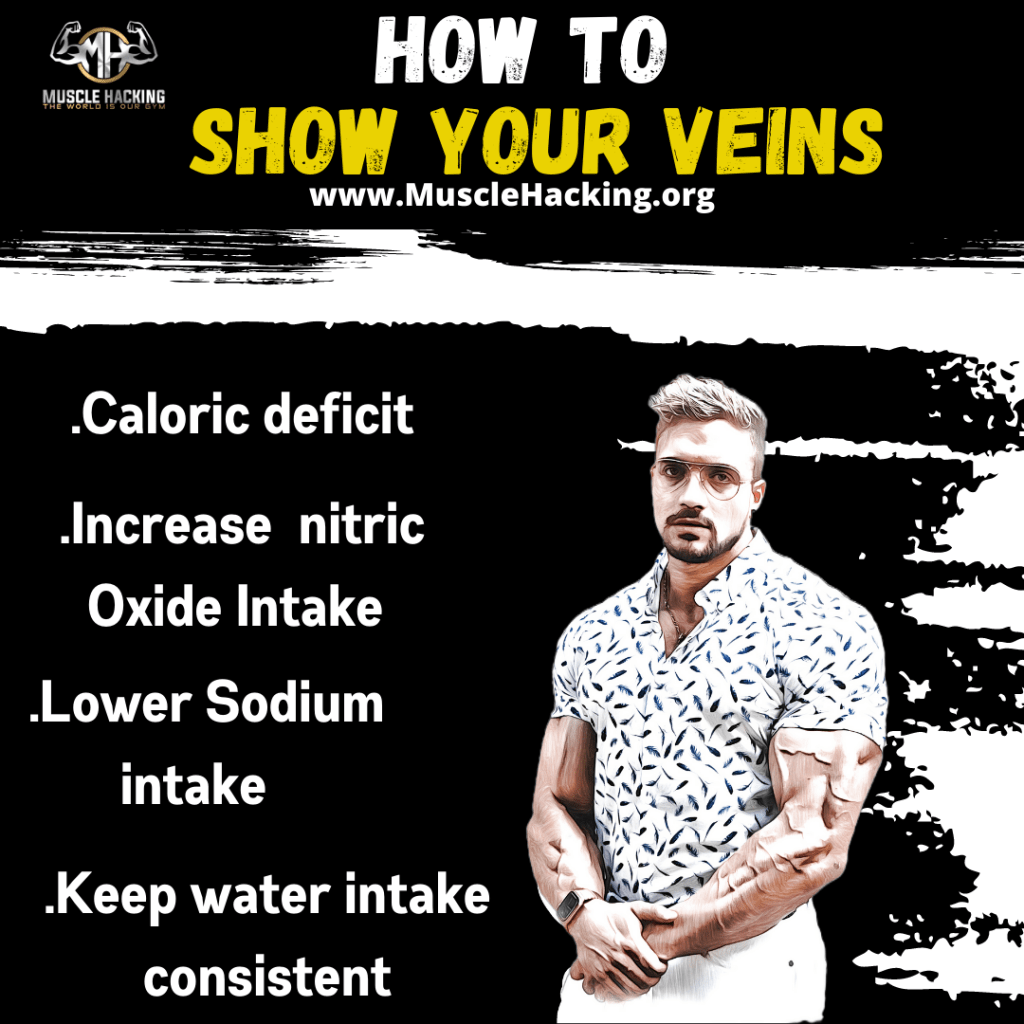
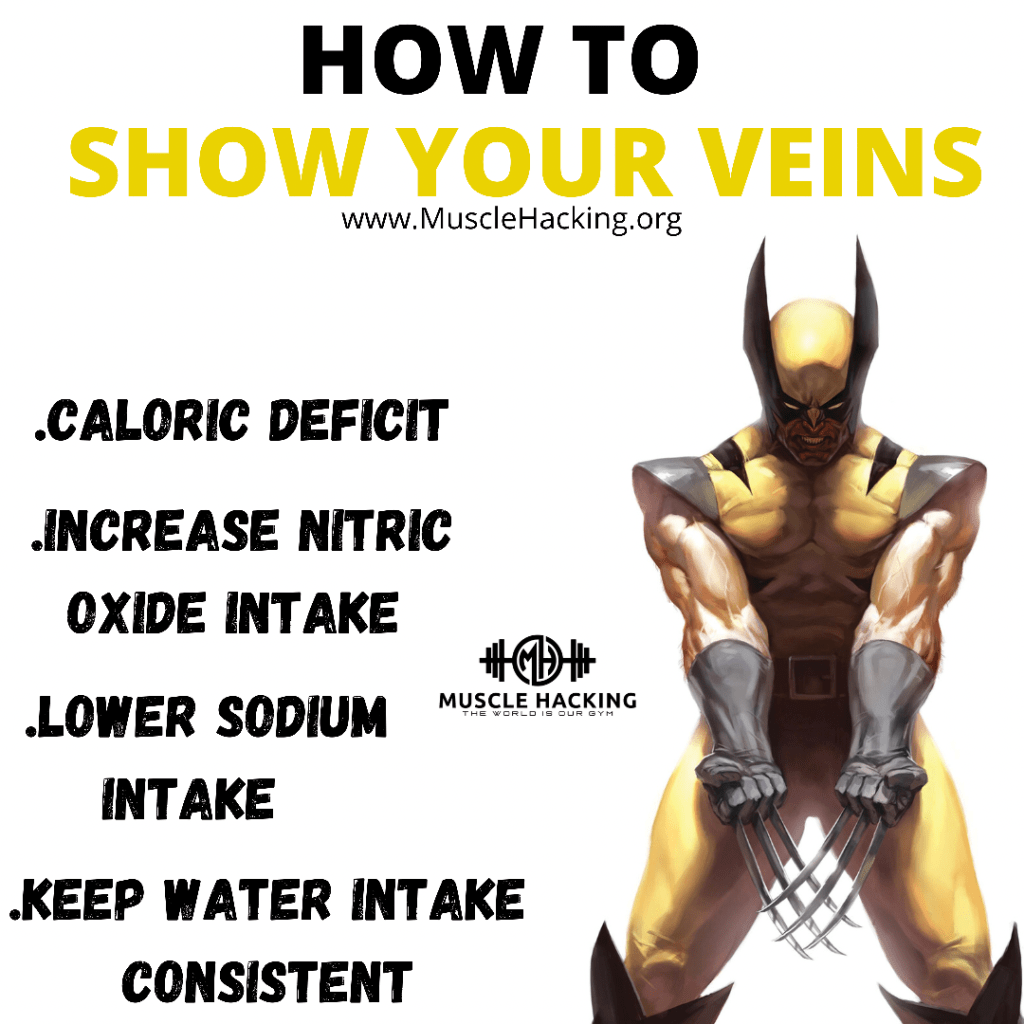
  • Caloric Deficit

🔹Science proves that if you want to burn fat, diet manipulations are more effective than doing extra cardio.

🔹Push towards getting under 15 percent body fat for some of you. To be sure though, aim for under 12 percent body fat.

🔹 You can never go wrong with leafy greens when it comes to gaining vascularity.

🔹 Most importants keep your calories at least 200 under your BMR

  • Increase Nitic Oxide Intake

🔹 Nitric oxide is the compound that is responsible for your veins to dilate; AKA get bigger. There are alot of foods out there that help increase the amount of nitric oxide in the blood to make your veins show.

🔹 Foods that that will convert into nitrates in the body will most definitely do the trick to up your level of nitric oxide. Eat foods such as:

.Beetroot
.Lettuce
.Celery
.Broccoli
.Arugula
.Spinach

  • Keep sodium intake low

🔹 Salt will hold onto water which is what you don’t want. In other words, the more salt that you have in your diet, the more water your body will retain, which means the less your biceps vein will show.

  • Keep water intake consistent

🔹 If you’re chronically dehydrated and not getting the amount of water your body needs, your body will start to crave water and will retain as much as possible whenever it has the chance.

🔹 Avoid dehydration so that your body will hoard less water and be willing to excrete any extra water.

Overhead Press

♠️Overhead Press♠️

⠀⁠

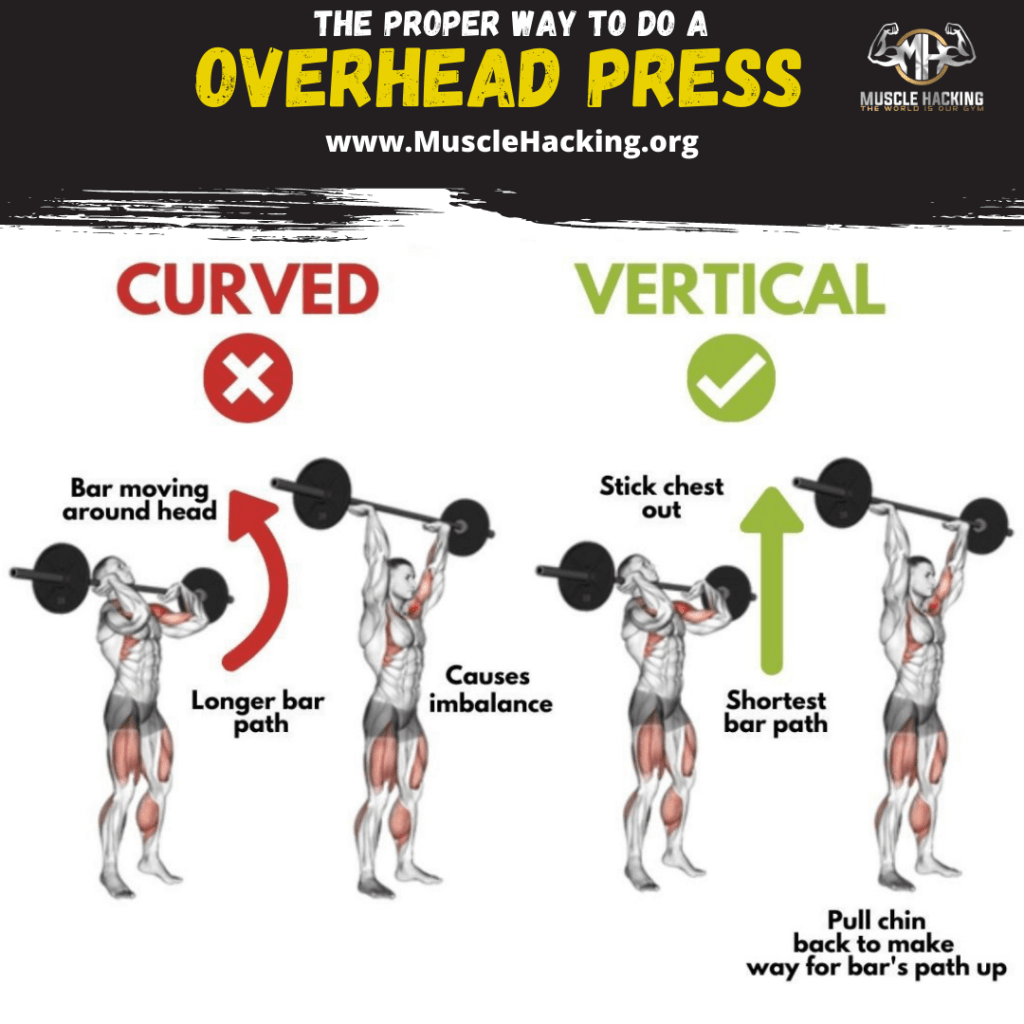
🔹 A common error I see (and that I have made myself) is to execute the overhead press with a “Curved” bar path.⠀⁠

⠀⁠

🔹 This extends the bar path and puts your shoulders in a fragile position that forces you to press less weight. This will hinder your progress because to build strength and muscle, you need more resistance/weight.

⠀⁠

🔹For a proper form, we want the bar to travel STRAIGHT up in a vertical line.⠀⁠

⠀⁠

– “But my head is in the way” you might say to yourself, and I don’t want you to press the bar through your head and hurt myself… so what should you do?⠀⁠

⠀⁠

🔹 So to tackle this, at the bottom of the motion, you can pull your head and chin back while simultaneously pushing your chest forward (while keeping your lower back neutral).⠀⁠

⠀⁠

🔹 Then, as you get to the peak, you stand with the bar right above your body, in a straight line.⠀⁠

⠀⁠

🔹 When lowering the bar, move your chin and head back and your chest forward as it was previously to get the bar past your head in a straight line.⠀⁠

⠀⁠⠀⁠

⠀⁠

Build Bigger Traps

♠️Build Bigger Traps♠️

🔹 Want to be a trap king or trap queen? You have to know this about growing bigger traps…

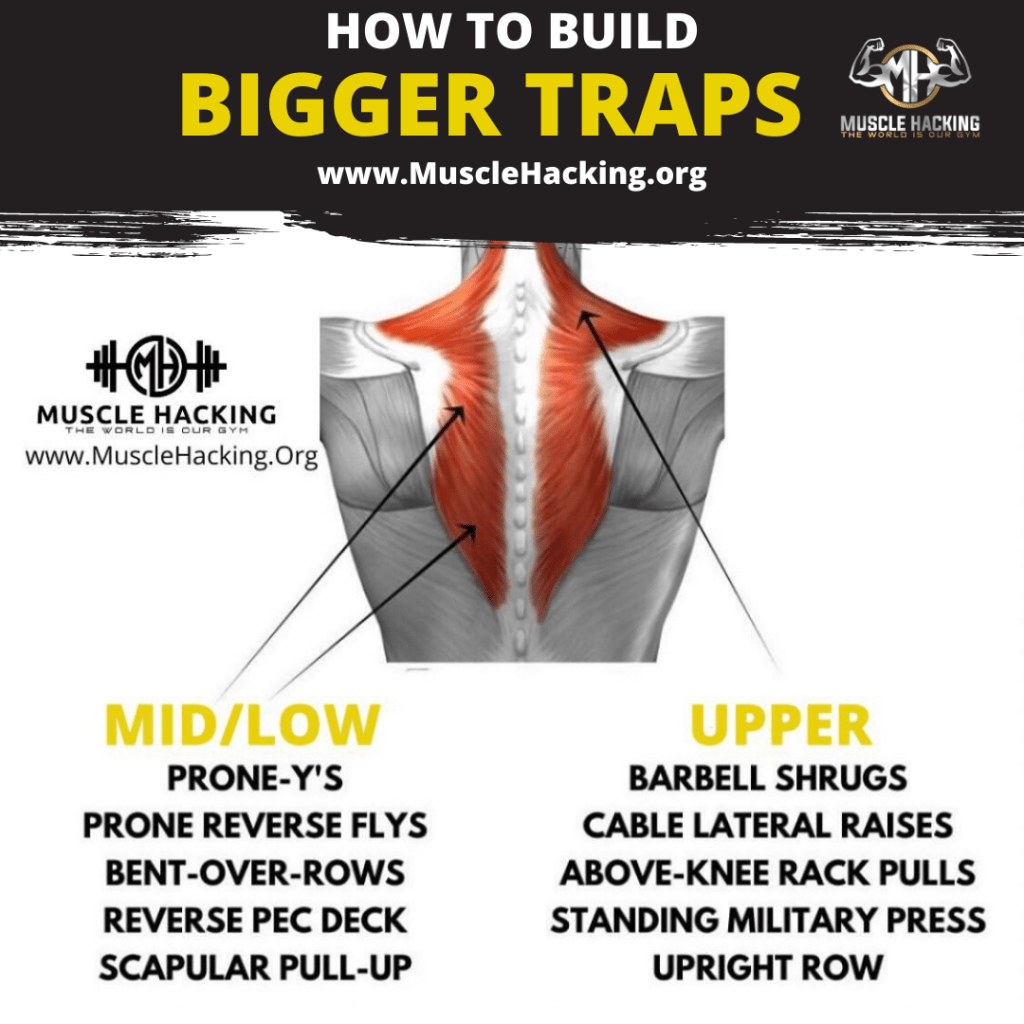
🔹 The trapezius are often recognized by the part that you see in the mirror, which are the upper portion of the traps. But the traps actually stretch down the back.

🔹 Training the traps requires more than performing shrugs. If you want to target the mid and lower part of your trapezius, try these workouts and watch the gains appear right before your eyes.

Prone- Y’s
Prone Reverse Flys
Bent Over Rows
Reverse Peck Deck
Scapular Pull Ups

🔹 And to target the upper part of the trapezius, try these out for size…

Barbell Shrugs
Cable Lateral Raises
Above The Knee Rack Pulls
Standing Military Press
Upright Rows

🔹 What’s your favorite trap workout?

Post Workout Recovery

♠️Recovery♠️

🔹 I can remember my first few months of strength training. I wanted a huge bench press, so what did I do? I benched 4-5x/week to the point that I over trained. Even worse; I killed my gains and my strength came to a hault. 

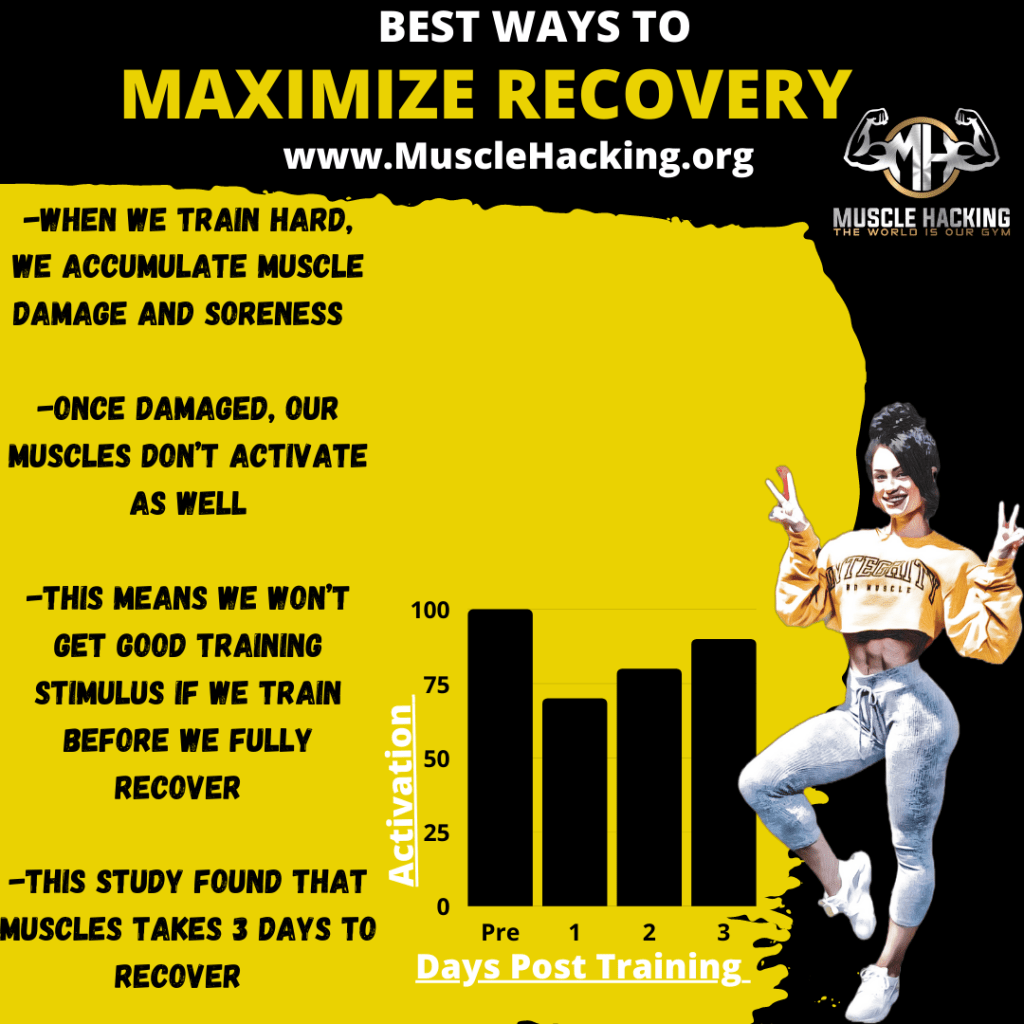
🔹 Studies show  that muscles takes around  3-days to recover from a hard workout. Recovery isn’t just feeling better or less sore, but a state in which your muscles are able to reach nearly full activation again. This is essential because a muscle has to be active in an exercise in order to grow from the stimulus. If soreness and fatigue are hindering muscle activation, your workout won’t cause your muscles to grow.

🔹 A prime rule of thumb to remember is  that you grow muscles outside of the gym. It’s important that you focus on recovery just as much as training. If you skip this critical step, you’ll find it difficult to reach your goals. Make sure that you give your muscles at least 48-72 hours of rest to optimize your recovery. This is very beneficial for the long run. 

Resources: https://pubmed.ncbi.nlm.nih.gov/12741861/

Boosting Metabolism

♠️Key To Boosting Metabolism♠️

🔹 If you are in a fat burning phase, you definitely want to focus on speeding up your metabolism through a phenomenon called the EPOC effect, which stands for, “Excessive Post-Exercise Oxygen Consumption.” The EPOC effect will produce more oxygen consumption to the body   in the post-workout period. This is beneficial because  when we consume more oxygen, we burn more calories. 

🔹 How and why does this happen?

🔹 Exercise will increase stress to the body. This interrupts our regular homeostasis. After our workouts, our bodies start to recover from this stress. Things such as tissue repair and nutrient replenishment require more energy, this is why we see increased calorie burning after we exercise. There are studies that show that this effect can last for as long as 38-hours. 

🔹 So let’s get to the question, “do all forms of exercise have the same effect”?

🔹 That’s precisely what this experiment investigated. Subjects performed workouts that burned the same amount of calories from resistance training, steady state cardio, and interval training. After that, they tracked their calorie burning throughout the post-workout period to see if there were any differences?

🔹 What were the results?

🔹 The steady state cardio group  didn’t boost metabolism one bit. Remember, the primary reason for an increase in metabolism  following a workout is due to things like tissue repair or nutrient replenishment. Steady state cardio typically isn’t stressful enough of a stimulus for most people so we don’t have as much muscle damage to repair or fuel stores to fill up.

🔹 On the other hand, both resistance training and interval training did increase metabolism. Both forms of exercise cause muscle damage and interval training will also deplete energy stores a little more than resistance training. Combine these two workouts and you’ll get a solid EPOC effect.

Resources:

https://www.researchgate.net/profile/Beau-Greer/publication/272187749_EPOC_Comparison_Between_Isocaloric_Bouts_of_Steady-State_Aerobic_Intermittent_Aerobic_and_Resistance_Training/links/56d264a608ae4d8d64a5f597/EPOC-Comparison-Between-Isocaloric-Bouts-of-Steady-State-Aerobic-Intermittent-Aerobic-and-Resistance-Training.pdf

https://minds.wisconsin.edu/bitstream/handle/1793/48951/Oschuenkemark2001.pdf

Training To Failure

♠️TRAINING TO FAILURE♠️ 

‘𝘐𝘧 𝘺𝘰𝘶 𝘥𝘪𝘥𝘯’𝘵 𝘵𝘳𝘢𝘪𝘯 𝘩𝘢𝘳𝘥 𝘦𝘯𝘰𝘶𝘨𝘩.. 𝘥𝘪𝘥 𝘺𝘰𝘶 𝘦𝘷𝘦𝘯 𝘵𝘳𝘢𝘪𝘯 𝘢𝘵 𝘢𝘭𝘭?’⁣⁣

⁣⁣

🔹’Training to failure’ has been a topic of discussion since I was in high school… but what does it even mean? ⁣⁣

⁣⁣

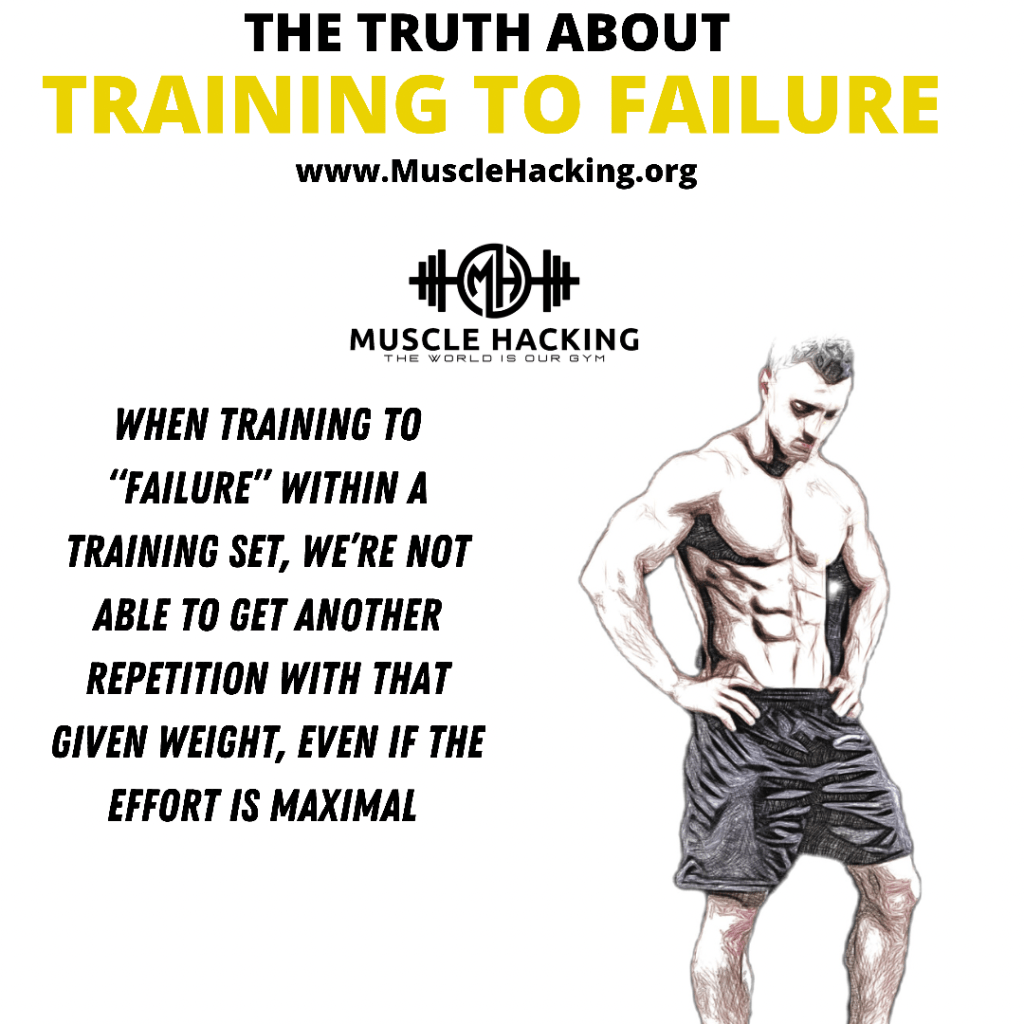
🔹Technically, training to failure can be defined as “the inability to complete the concentric portion of a given lift without substantially deteriorating your technique.”⁣⁣ 

🔹When we refer to ‘failure’ we actually mean ‘task failure’ and not ‘muscular failure’ because in reality it’s not our muscles that fail, but rather our ability complete the given task with a given weight. ⁣⁣

⁣⁣

🔹Is it important to train to failure?⁣⁣

⁣⁣

🔹While it’s certainly not optimal to ‘always’ train to failure, the opposite isn’t true either, let’s dive in… 

⁣⁣

🔹For any given set, there’s an amount of adaptation stimulus and fatigue that comes along with it. Training to failure definitely increases the amount of CNS fatigue we may experience, which could be sub-optimal for future workouts – HOWEVER – if we never experience true (task) failure, we may never be able to reach the required amount of effort threshold that we need to stimulate growth, because we wouldn’t be as precise at dictating it.⁣⁣

⁣⁣

🔹Of course this comes more with experience, and the more advanced you’ll get the more precise you’ll be at performing the exercise correctly under high intensities.⁣⁣

⁣⁣

🔹Personally, as a fitness coach, I believe it’s important to understand what failure actually is and what it feels like, so that we’re more likely to be precise in how we rate our perceived effort exertion within a given set. Because we’ll still need to train close to it, for the stimuli to be meaningful. This means that here and there, it’s actually a good idea to be prescribed a set of X reps to RIR 0 for a set of an exercise. Feel it. Understand it. Learn it. ⁣Don’t hesitate to message me if you have any questions. 

🔹If you want to transform your physique to the next level message the word “Discipline” and I will set up a consultation call. 

References:

1) https://www.frontiersin.org/articles/10.3389/fphys.2016.00010/full

How To Show Your Veins

  • Caloric Deficit

🔹Science proves that if you want to burn fat, diet manipulations are more effective than doing extra cardio.

🔹Push towards getting under 15 percent body fat for some of you. To be sure though, aim for under 12 percent body fat.

🔹 You can never  go wrong with leafy greens when it comes to gaining vascularity.

🔹 Most importants keep your calories at least 200 under your BMR

  • Increase Nitic Oxide Intake 

🔹  Nitric oxide is the compound that is responsible for your veins to  dilate; AKA get bigger. There are alot of foods out there that help increase the amount of nitric oxide in the blood to make your veins show.

🔹 Foods that that will convert into nitrates in the body will most definitely do the trick to up your level of nitric oxide. Eat foods such as:

.Beetroot

.Lettuce

.Celery

.Broccoli

.Arugula

.Spinach

  • Keep sodium intake low

🔹 Salt will hold onto water which is what you don’t want. In other words, the more salt that you have in your diet, the more water your body will retain, which means the less your biceps vein will show.

  • Keep water intake consistent

🔹 If you’re chronically dehydrated and not getting the amount of water your body needs, your body will start to crave water and will retain as much as possible whenever it has the chance.

🔹 Avoid dehydration so that your body will hoard less water and be willing to excrete any extra water.