Sumo Deadlifts are a great variation to the conventional deadlifts if you want to grow stronger and bigger quadriceps and glutes. ⠀ But the Sumo DL’s are still targeting your hamstrings, traps, upper back muscles, and lower back (and many more). ⠀ The Sumo Deadlift helps improve your posture and can be a great variation if you have mobility and flexibility issues or bone structures that are not suited for the conventional DL. ⠀ The Sumo DL is also easier on your spine, while you can still load it extremely heavy.
Mechanical Tension is the main driver of muscular hypertrophy, yet, if we want to maximize results, we need to understand what it is and how we can play around with other variables such as Volume and Frequency to really get the most out of it.
In fact if mechanical tension is the stimulus, Volume is what allows us to replicate this stimulus multiple times, so that we can reach the threshold at which the cascade of hypertrophic events are triggered.
Simply increasing the number of times that we can trigger this stimulus, howvever, isn’t necessarily the answer, or at least it isn’t after a certain point… and that’s because with volume, we need to take in consideration variables such as fatigue as well, where “simply doing more” ends up decreasing the quality and effectiveness of our work.
That’s when frequency comes into play to really maximize the quality of our training program: research shows that training muscles multiple times per week (2x is more than enough) maximizes the hypertophic outcomes of a training plan, and that’s because when volume is broken down into multiple sessions we lower the amount of fatigue we accomulate per training session, and simultaneously increase the quality of these sets, with greater energy levels.
Learning the role of each variable will offer the tools to maximize the results of a training plan with the goal of hypertrophy.
Well.. you already know the answer. Stubborn fat, just like any other fat, is lost by creating a caloric deficit through a mixture of dieting and exercising. First of all we need to get lean enough to tackle those areas (at least ~12% for men and ~22% for women) but once we’re there, they’ll go just as fast as other areas (assuming we’re eating the right amount of nutrients and training the right way). The main issue with dieting to very low levels of body fat is that as we get leaner, hunger increases and our energy expenditure decreases due to adaptive mechanisms that “negatively impact” the speed at which we lose fat. So our deficit becomes smaller and smaller and our results start slowing down. it’s not necessarily the fat that is stubborn it self.. I mean, even if it is, your body will have to take energy to use from somewhere, and if protein intake is high enough to avoid wasting protein for energy and enough resistance training is provided as a the stimulus to maintain muscle mass.. the ln this energy will come from stubborn fat cells. Plain and simple. Sure, there are specific strategies that may work specifically for these areas (such as introducing low carb diets or use of specific supplements combinations such as Caffeine + Yohimbine HCl, which are able to decrease Alpha-2 receptor activity and mobilize the fat out of the cell), but don’t forget the bigger picture.
Being extra patient, more accurate (with both food intake and daily activity) will get the job done. It sucks, but it’s true.
Is muscle memory real? No training = no stimulus, and as a consequence, we can experience muscle loss. How hard is it to regain lost muscle ? It turns out, “Muscle Memory” is real, and as many of us have likely experienced, it’s far more easy to regain lost muscle, than it is to gain it for the first time. In fact, our muscle fibers seem to have an “epigenetic memory” which defines the changes that the cell’s DNA undergoes, including informations about its previous size. Even though we experience muscle loss rather quickly after a period of detraining, we don’t actually lose the number of myonuclei. This increases the amount of resting MPS, and makes it much easier to regain lost muscle once we’re back to training. In addition, motor unit recruitment appears to decrease slowly in contrast to muscle size. This means that once we’re back to training, we’ll be able to still recruit a good number of muscle fibers, and still exert high amounts of force, compared to when we previously started training.. which again, will allow muscle regrowth to occur at a much faster rate!
I know feeling that soreness 1-2 days after a workout can be super satisfying.
It makes you feel like you worked hard and got in a really awesome workout.
The problem is that you also get sore because you did something new or different, not only because your workout was necessarily good.
It’s best to evaluate the effectiveness of your workout based on how you’re improving, not based on how sore you are.
Changing your workout too much gives you that sore feeling but doesn’t allow you to actually progress with your strength.
You have to stick to the same lifts for awhile and get stronger with them to utilize progressive overload and give your muscles a reason to adapt and get stronger.
You can get sore from increasing increasing the weight of some lifts or doing extra reps but it’s generally not the same level of soreness.
If you want to get stronger and see the best results, stop chasing that feeling of soreness and changing exercises all the time
Stick to a plan and get better and better at that. Once you start to plateau then you can change your plan.
Soreness doesn’t mean better.
Getting stronger means better.
If you’re looking to burn extra fat, download my Free Ebook
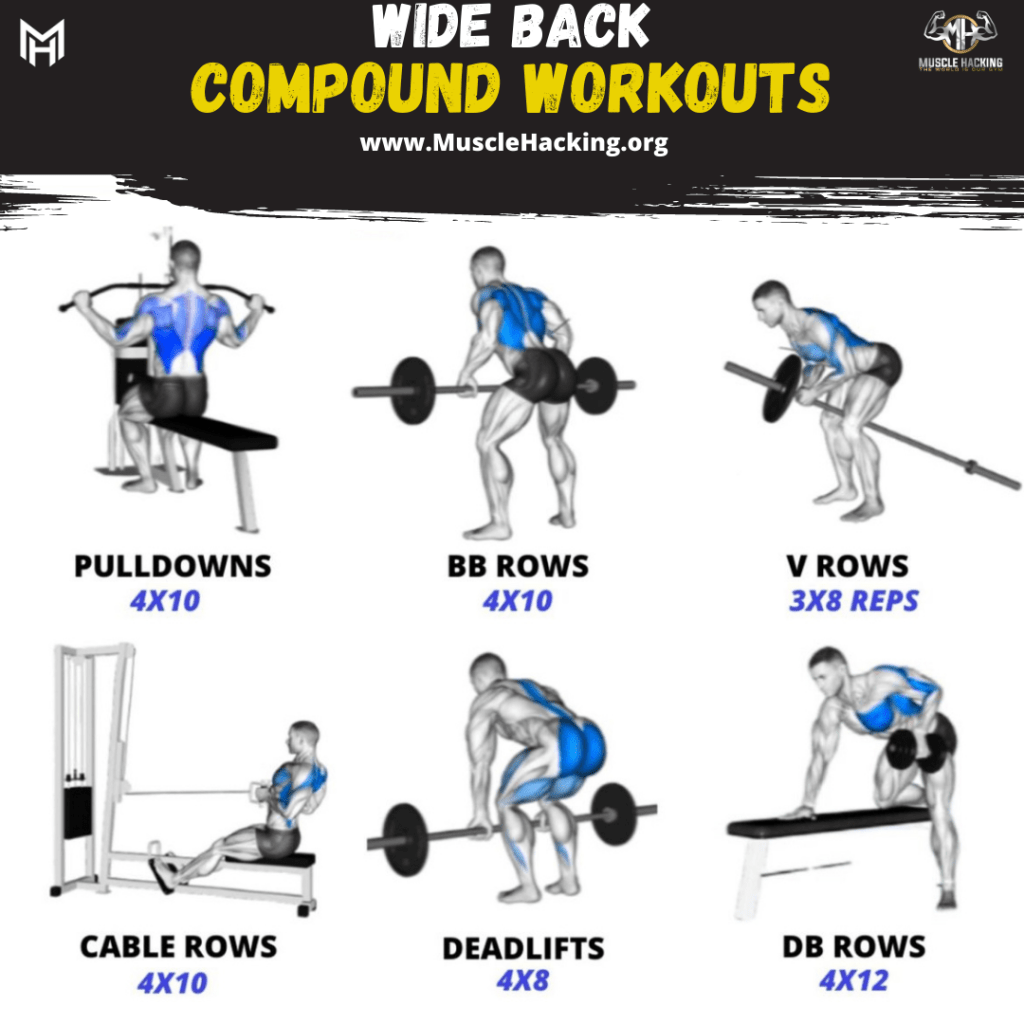
Wide Back Workout This is mainly for more advanced gym goers as it contains over 20 sets for your back muscles. If you really want to do this, I’d recommend starting with your heavier lifts, like the Deadlift and Barbell Rows/Pull-Ups, and then move over to your Lat Pulldowns, and then you can finish with Cable, V-Rows, and DB rows. You can use higher weights, lower reps, and longer rest time for your first exercises, and then decrease weights increase reps, and decrease rest time as you move through your workout. As always: Focus on performing the exercises with proper form and technique. Approach this with caution
The food choices we make each day (and in what quantities) will largely impact how much progress we make on our goals — whether they may be fat loss, muscle gain or both at the same time (recomposition).
Additionally, these same food choices will determine how HUNGRY or how FULL we are day to day, and will ultimately affect how we feel, and how sustainable with our nutrition we can be.
So while you CAN eat anything you want to eat and make progress at the same time, controlling portions and selecting foods that better support your goals is very important!
So, take home message is this… don’t eat less, EAT RIGHT (at least most of the time)!
Controlling Your Body Fat ▪️As modern research progresses, there seems to be more data backed by the “Set Point theory” which suggest that a biological system may be responsible for metabolic changes. ▪️The research is not absolute on the matter and specific mechanisms remain unclear, but this may produce some “food for thought” to those who believe that the set point doesn’t exist. Some say that it should be preferably called “Settling point” and that it’s more involved with environmental factors rather than physiological ones. ▪️Others advocate that the two (set and settling points) can coexist and should not be mutually exclusive, which is more likely the case. ▪️I digress.... ▪️Have you ever noticed your body trying to fight back when your goal is to lose body fat? As you continuously lose weight, you feel more lethargic, hungrier than normal and, before you know it, you’re back to the weight that you started with. ▪️On the other side of the spectrum, when you start bulking (and do so for a while) suddenly eating all the calories becomes more difficult, hunger decreases and.. you actually start losing weight. ▪️How does this happen? ▪️When we start losing fat, our appetite increases, and that is largely due to a hormone called leptin, which is produced by the fat cells. ▪️In other words, more triglycerides within the cell creates more Leptin, which will increase metabolic rate and decrease hunger. ▪️However, less triglycerides within the fat cells will lead to less Leptin, which decreases metabolic rate and increases hunger. ▪️Based on out genetics, we tend to maintain a certain body weight and body fat, and if we start to fluctuate, then our appetite, behavior, and energy expenditure tends to adjust accordingly. Reference: https://pubmed.ncbi.nlm.nih.gov/34074915/
▪️The majority of diets involve lowering your calorie intake to create a calorie deficit, meaning that you’re consuming less calories than you’re burning.
▪️Over a period of time, your body will start to adapt, which will slow down your metabolism in an effort to conserve energy.
▪️This can become a problem once you’re ready to start back to having a normal diet but want to maintain your weight — or when you hit a weight loss plateau and are unable to further decrease your calories.
▪️Reverse dieting normally involves increasing calorie intake by 50 to 100 calories per week above your baseline levels, which is the number of calories you have to consume to maintain your weight.
▪️This phase lasts between 4 to 10 weeks, or until you reach your goal, pre-diet intake.
▪️️Because protein intake is typically calculated for body weight rather than calorie consumption, your protein intake should remain the same throughout the reverse phase.
▪️Increasing your calories can boost metabolism and enhance fat burn through non-exercise activity thermogenesis (NEAT), which includes everyday actions such as walking, talking, and even fidgeting.
▪️Reverse dieting can also stabilize your hormones, like leptin, which regulates your appetite and body weight.
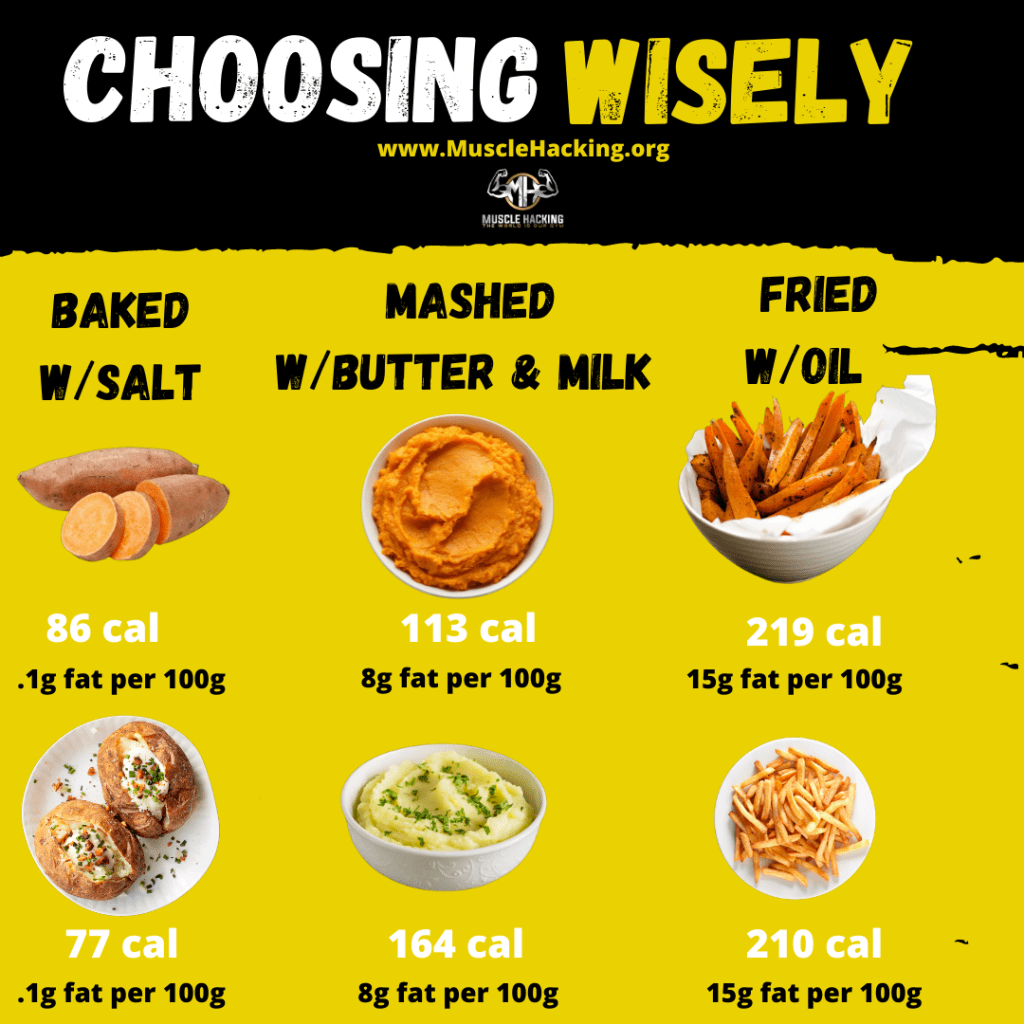
▪️Here’s an idea of what your potatoes can cost you in calories. It’s imperative to understand the energy density of the food you eat. Not all food is created equal no matter how similar it may look on your plate.
▪️Potatoes for instance, vary in calories based on their type and also by the way they are prepared.
▪️Here’s a few reasons how food appearing similar can vary: -Cooking methods -Types and brands -Additives like butter, milk and oil.
▪️Be conscious of the amount of calories and the preparation method of the food that you are eating. Especially if you’re looking to shed some extra fat.
▪️Ultimately, in order to lower your body fat percentage, you need to be in a calorie deficit. When you are focusing on calorie awareness while choosing potatoes; aim for the lower caloric option such as steamed potato or the variation without any cooking additives.
▪️Where you are consuming a higher calorie and higher fat potato like chips; you should make sure that your other food choices throughout the day compensate for this by being high protein, high fiber and nutrient dense.





 musclehacking.org