Screwed Up Your Diet?

Screwed up your diet ? Here’s a muscle hack to get back on track quickly

▪️Breaking diets happens to best of us the first times we dieted, and it happens very frequently to beginners but also “advanced” dieters as well.

▪️When it comes to burning fat, we need to create a calorie deficit of around 3500 calories which is roughly 1lb of fat loss. This means that if we have to eat -500 calories, under maintenance, per day we would need a week of dieting to lose 1lb of fat. ⁣

▪️So if we were able to do that.. we would lose all the fat right ? Well sort of, yeah, if we don’t take into account any metabolic adaptation, that’s how it would work in theory. ⁣

▪️But what really happens is that people… screw it up… And it’s totally fine.⁣

▪️It’s just life. Whether it’s because you don’t feel like dieting or whether it’s because you were offered something you couldn’t resist saying no… screw ups happen, and “being perfect” is not what we’re looking for. ⁣

▪️What we need to get better at, is to quickly get back on track in order not to lose the progress made: this means being consistent, not perfect. ⁣

▪️Something that “clicked in my mind” back in the days, when information wasn’t so readily available and I used to screw up my diets too, was to understand that “if 3500 calories under maintenance” are needed to lose 1lb of fat, then “3500 calories OVER maintenance will result in roughly 1lb of fat”. ⁣

▪️For how obvious that may sound, you rarely over eat that much over your calories

▪️The point I’m trying to make is that, even if some days “you screw up” a little and eat a couple hundred calories extra, you’re still good. it doesn’t mean you lost all your progress.⁣

▪️Even if you went above your maintenance, you would need to eat +3500 calories over it to gain 1lb of fat, so a couple hundred calories, for one day, won’t even be worth calculating. ⁣

▪️But the scale says otherwise ? It doesn’t matter what the scale says: even if it went up by a couple pounds the next day, following a higher calorie day, it’s just water retention, at least most of it. Not gained fat. ⁣
Diet Breaks

-Diet Breaks

▪️The concept of taking ‘Diet Breaks’ was first initiated and publicized by Lyle McDonald in his innovative book called “A Guide to Flexible Dieting”, and in the last few years more research has been accumulated on that matter. ⁣

▪️Have you ever started a diet break with the purpose of dieting “better” later ? Sounds counter intuitive, but it’s exactly how diet breaks work. ⁣

▪️And for the record, I’m not talking about cheat days or days where you simply stop dieting because you “don’t feel like it”. I’m talking about diet breaks, which actually serve a purpose to your progress and your fitness journey.⁣

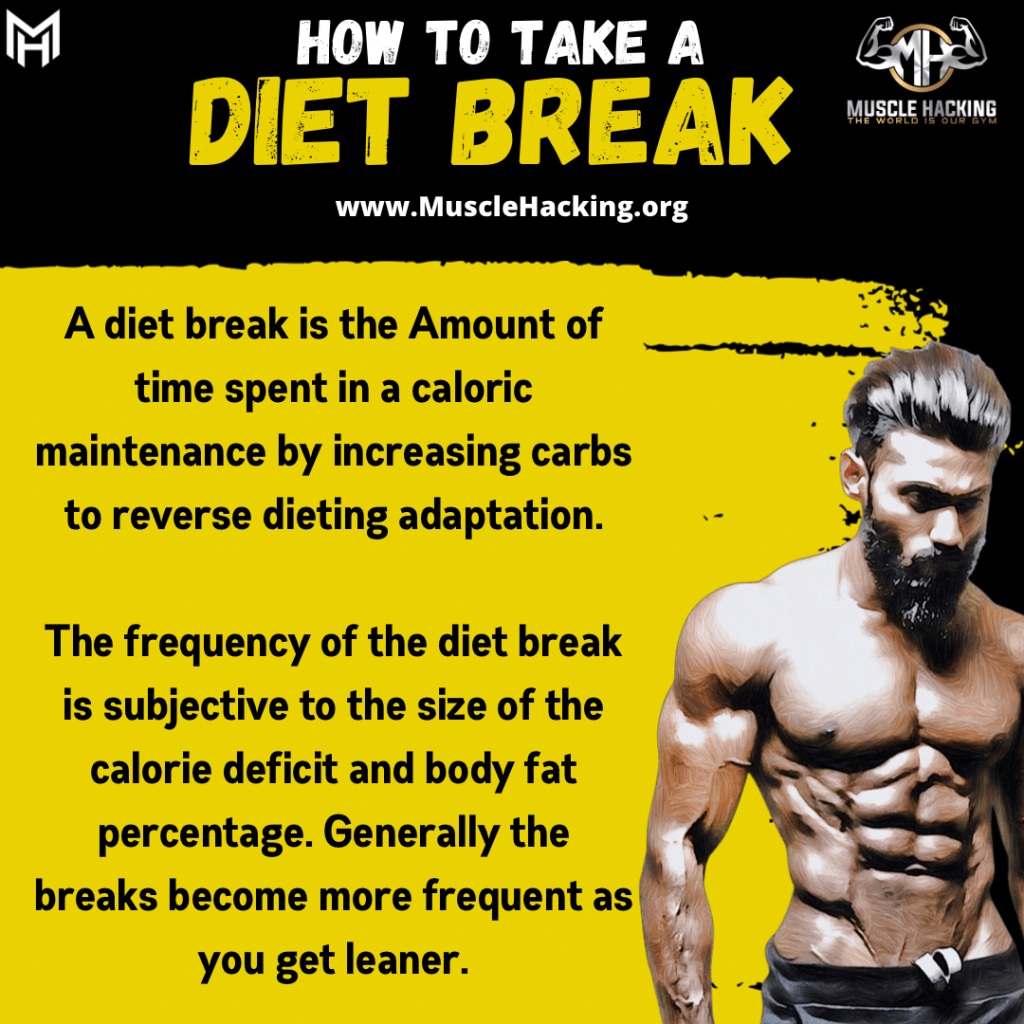
▪️Diet Breaks are essentially short periods of time, between 10 to 14 days, spent at an estimated maintenance, where calories are elevated by increasing carb intake to reduce hunger. This can potentially speed up your metabolism, increase energy expenditure, and regain some lost strength e while simultaneously losing some water weight.

▪️Studies show that periods of caloric restriction followed by small “breaks” at caloric maintenance, will result not only in better fat loss, and an increase in muscle mass, but weight is actually easier to keep off in the long term. ⁣

▪️And this happens for two reasons: both physiological and psychological ones. ⁣

▪️I’m not saying that dieting all at once doesn’t work, because obviously it does (a caloric deficit will always work). Also if you’re dieting for a close competition, you won’t have enough time to implement diet breaks in your prep.

▪️However, if you are not dieting for a competition and you would like to get lean, the implementation of diet breaks is certainly going to work better for long term maintenance. ⁣

How To Burn Fat

-How To Burn Fat

▪️Losing weight fast isn’t a sustainable solution, if it isn’t something you can keep doing for a longer period of time.⁠
⠀⁠
▪️So if there’s a diet, pill, book, or something else that promises to magically transform your body in 2-weeks, it’s probably too good to be true.⁠
⠀⁠
▪️Fat loss can be incredibly simple in nature, but many media outlets overcomplicate things.⁠
⠀⁠
▪️What we need to do is consistently exercise. We also need to consume nutritious food and stay in a caloric deficit.
⠀⁠
▪️Creating these habits can take some time, that’s why the extremely restrictive diets don’t work in the long run for most people. And the good news is that you don’t need them to burn fat.⁠
⠀⁠
▪️Another thing that helps a lot is support from a partner, friend, family member or an awesome coworker, who helps you get through some of the tougher obstacles.⁠

Muscle Memory

♠️Muscle Memory♠️
⁣⁣
🔹 No training will lead to no progress and consequently we can experience muscle loss aka atrophy. ⁣

🔹 How hard is it to regain muscle you might ask? ⁣

🔹 It turns out, “Muscle Memory” is real, and the majority of us have likely experienced it. It’s far easier to regain lost muscle, than it is to gain it for the first time. ⁣

🔹 Our muscle fibers have an “epigenetic memory” which means the changes that the cell’s DNA goes through, including information about its previous size can be replicated over again.

🔹 Even though we will lose muscle mass after a period without training, we don’t actually lose the number of myonuclei. This increases the amount of resting muscle protein synthesis, and makes it much easier to regain lost muscle once we’re back to training. ⁣

🔹 In addition, motor unit recruitment seems to decrease slowly in comparison to muscle size. ⁣

🔹 This means that when we start back working out, we’ll be able to regain a good number of muscle fibers, and still apply high amounts of force, compared to when we previously started training.. which will allow muscle regrowth to happen at a much faster rate.

Reference: https://medium.com/oxford-university/the-amazing-phenomenon-of-muscle-memory-fb1cc4c4726

Stress Affects Fitness Gains

-How does mental stress
affect your strength
recovery?

▪️ Mental stress has been
shown to have lots of
negative effects on
physiology. However, is
stress also something you
should manage for optimal
recovery in the gym?

▪️This study investigated
whether mental stress
impacts your recovery
from heavy resistance
exercise.

▪️ Subjects were categorized into
groups based on their stress level.
The subjects first established their-
10 rep max (10RM; the
maximal weight they are able ton use for 10
reps). After the subjects performed 10 reps, they did another 6 sets to failure at 80-90% of their 10 rep max
weight.

▪️ Each group saw a huge
reduction in muscular force
immediately after their workout.
and. While all groups recovered
some strength in the following
hour, strength recovery was
lower in the high-stress group.

▪️ Therefore,
managing mental
stress is not just
important for your
overall health, but
should also be
taking into account,
in your training
schedule.

▪️ In conclusion, high mental
stress has a negative effect.
on short-term muscle
strength recovery
after a heavy lifting session.

How do you manage
your stress?

Resources: https://pubmed.ncbi.nlm.nih.gov/
22688829/

Maximize Muscle Growth

-What mistakes have you made when trying to build muscle?

▪️Remember: building muscle does not require you being in a huge calorie surplus. Getting fat is not the answer…

▪️Instead, get to a body fat percentage you feel energized and comfortable on and from there start to slowly add on muscle without getting fat (eating around maintenence). No one wants to get fat and then diet severely for 6 months, it’s pointless…

▪️Bulking is not only unefficient but is very unhealthy as well because of the weight fluctuations you’ll be going through…

More Effective Workouts

-Make your workouts more effective readjusting your training priorities

▪️The main principle of muscle growth is progressive overload which means consistently increasing the resistance you put against your muscles, hence forcing them to adapt and grow bigger and stronger…

▪️Training intensity, or the effort you put during the workouts, is crucial for ensuring that you perform at your maximum potential. Remember, intensity is more beneficial for muscle growth than volume. After all, you can do 10 sets or an exercise, but if you never get our of your comfortable rep range, your body will never have a reason to grow. Thus, make sure you always workout at high effort and close to failure…

▪️The overall quality of the workout can be measured in different ways. But if you go to the gym and feel stronger than the last time, then you’re doing great!

Training To Failure

How Often Should You Train To Failure?

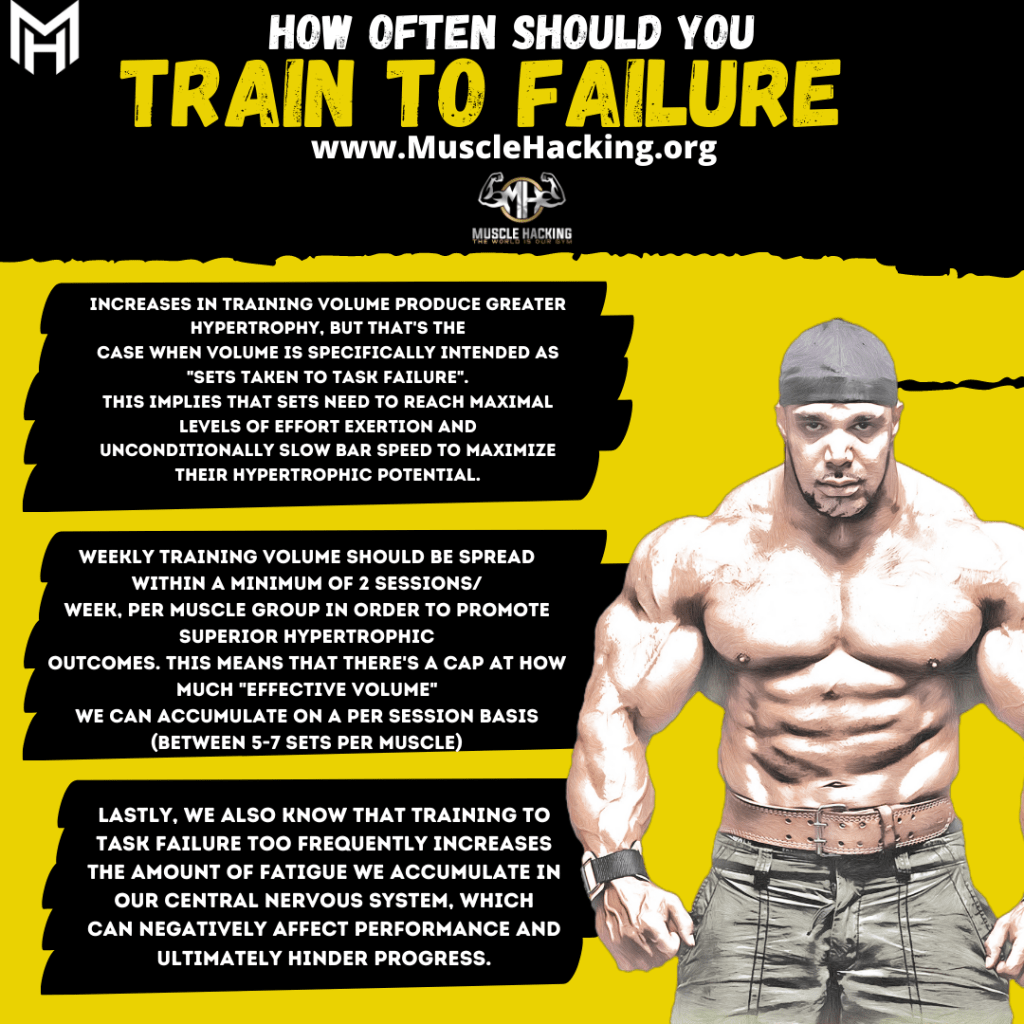
▪️Training to task failure (reaching the point at which we’re no longer able to complete another repetition with that given weight) is the only definition of volume that is directly correlated to hypertrophy.. however, that doesn’t mean that stopping before failure doesn’t create hypertrophy, provided the right context.⁣

▪️In fact, depending on how much volume load (reps x sets x weight) we perform and accumulate weekly we can decide how often we should go to failure to maximize hypertrophy.⁣

▪️Less weekly volume -> reach task failure more often. (Even if you accumulate fatigue, you have plenty of time to recover)⁣

▪️More weekly volume -> reach task failure less often. (By not training to failure often, you don’t accumulate excessive fatigue)⁣

▪️In a sense, the amount of failure training we perform is inversely proportionate to the amount of weekly volume and frequency we choose to train with, where lower training volumes can be seen as “more efficient” ways to train.

▪️Keep in mind that a “more efficient” program is not necessarily the best one, for everyone.

▪️Some may dislike/not know what training to failure means, and they may want to pick a “softer” approach which can still bring results by increasing training frequency/total volume.

▪️Others may find no meaning in training at sub-maximal effort levels, and may prefer a lower frequency/volume with very hard training.

▪️This is extremely subjective, and many variables do dictate the variability of these recommendations.

Lat Pull Downs

-The Difference Between Close Grip vs. Wide Grip ⠀⁠
⠀⁠
▪️There’s a lot of confusion around using a wide or a close grip during lat pulldowns, mainly people saying that a wider grip will build wider lats (Latissimus Dorsi)….⠀⁠
⠀⁠
▪️But from the research I’ve read, it seems that wider grip during lat-pulldowns will target your Teres Major muscle more, which isn’t a bad thing.⠀⁠
⠀⁠
▪️The Teres Major is usually an overlooked muscle and if ignored, it can lead to underdeveloped back muscles.⠀⁠
⠀⁠
▪️However, using a closer grip during the lat pull-downs will target your Lats, as well as your biceps, more than a wide grip.⠀⁠
⠀⁠
▪️So, what does this mean?⠀⁠
⠀⁠
▪️You could incorporate both into your training by switching the grip every set, week or month, depending on your training frequency and your goals.⠀⁠
⠀⁠
⚠️ Save this for your next Pull-Up day! ⚠️⠀⁠
⠀⁠
Research resource: pubmed.ncbi.nlm.nih.gov/24662157

Protein Before Workouts

  • Protein Before Workouts

If you haven’t consumed protein in the three to four hours after your workout, then it’s a good idea to consume between 30 to 40 grams before your workout. If you have ingested protein in the last few hours, though, then you don’t need to eat more. Instead, you can eat after your workout. Now let’s take a minute to dive into this advice because it helps you understand pre-workout nutrition better and nutrition and muscle building on the whole. We recall that as far as muscle building goes, eating protein does two vital things:

  1. It bumps muscle protein synthesis rates and suppresses muscle protein breakdown rates.
  2. It gives your body the raw materials that are needed in order to build muscle tissue.

This is why you must eat enough protein every day to maximize muscle growth. However, while there’s evidence that eating protein before a resistance training workout can magnify its effects on muscle protein synthesis rates, the results don’t appear to be strong enough to support the claim that having protein before an exercise is superior to not having it beforehand.

Instead, pre-workout protein is best viewed in the context of your entire diet.

If you haven’t eaten protein three to four hours preceding your workout, your body’s muscle protein synthesis rates are going to decrease to a low baseline level. Unfortunately, this means that your body’s muscle-building machinery will be idle, waiting for the next feeding of protein to kickstart it into action.