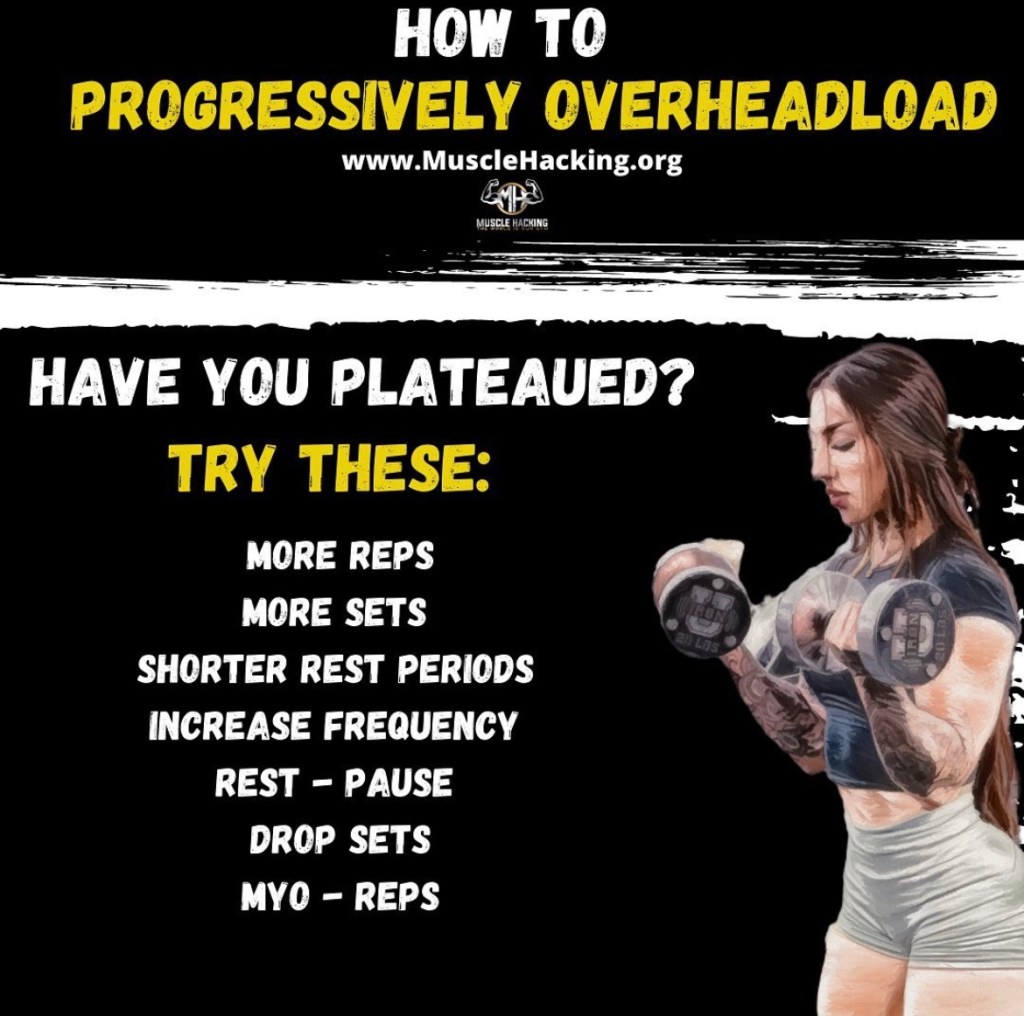
Progressive Overload ⠀ ▪️ What does progressive overload mean? ⠀ ▪️ Progressive overload is when you continuously increase the demands placed on your body through exercise. ⠀ ▪️For the most part, the goal is improve muscle hypertrophy (muscle growth) or strength. ⠀ ▪️Most of the time people plateau when doing this because they only try to increase the weights, but that can limit you if this is your only strategy. ⠀ ▪️So Yes, you can add more weights, but unless you’re ok with only having a hammer in your toolbox, it’s best to put a variety of tools in your toolbox. ⠀ ▪️Doing this can get you a diversify your progressive overload strategy, and ultimately, increase your hypertrophy and strength gains. ⠀ ▪️ You can also change the tempo of your lifts, decrease the rest intervals between sets, increase the amount of reps or sets, as well as incorporating different training methods such as the rest-pause or drop sets. ⠀ ▪️So there are definitely numerous ways to progressively overload than just increasing weights.
Here are four essential movements that will target the prominent parts of your upper body. ⠀ 1️⃣ There are several Bench Press variations, I always look forward to hitting the Flat Bench Press and Incline Dumbbell Press. ⠀ 2️⃣ For Pull-Ups, I like doing weighted Chin-ups because they’re less strenuous on the shoulders and they also target the biceps. ⠀ 3️⃣ Overhead Presses are one of the best workouts for targeting your deltoids and your upper chest. My go to is the standing barbell overhead press. ⠀ 4️⃣ Rows have many variations as well. I like doing the barbell row because it’s better for me to progressively overload with heavyweights.
▪️Protein: When you are consuming protein, your body starts to break down the protein molecules into amino acids and uses them to rebuild new muscle tissue. If you don’t take in enough protein, your body will not get enough amino acids, which will impair your ability to build and repair muscle.
▪️The average sedentary individual can “survive” with very little protein because of the survival mechanism that we inherited from our ancestors. These mechanisms allow us to reuse broken down protein. The fact of the matter is, you would die if you didn’t consume protein, but you can easily survive on tiny amounts. But if you’re reading this, chances are you’re not an average sedentary person, right? Since you regularly lift weights, your body will require more protein intake. In fact, research has discovered that athletes need to eat a high protein diet in order to maximize their performance.
▪️Fats: Dietary fat is the most calorically dense source of energy to the human body. Each gram of fat has twice the amount of calories as a gram of carbohydrates or protein. You can find healthy fats in dairy, meat, eggs, oils, nuts, and fish. These fats give your body the ability to absorb nutrients.
▪️Carbohydrates: A study published in The American Journal of Clinical Nutrition discovered that when participants were put in a 50% caloric surplus—either purely from consuming carbs or purely from consuming fats—after one day of overeating, the carb-only group stored only 10% of excess calories as fat, vs the fat-only group which stored a whopping 60%. In a nutshell, excess dietary fat will lead to greater fat accumulation than consuming an excess of carbohydrates.
▪️Looking at the bigger picture, this actually makes perfect sense. Especially since there are numerous sources of evidence that shows that carbs are inefficiently stored as body fat even when overfeeding. This process is due to a highly regulated metabolic pathway called de novo lipogenesis.
▪️Carbohydrates are sugars, starches and fibers which can be found in fruits, grains, vegetables and various milk products. Their main influence revolves around energy.
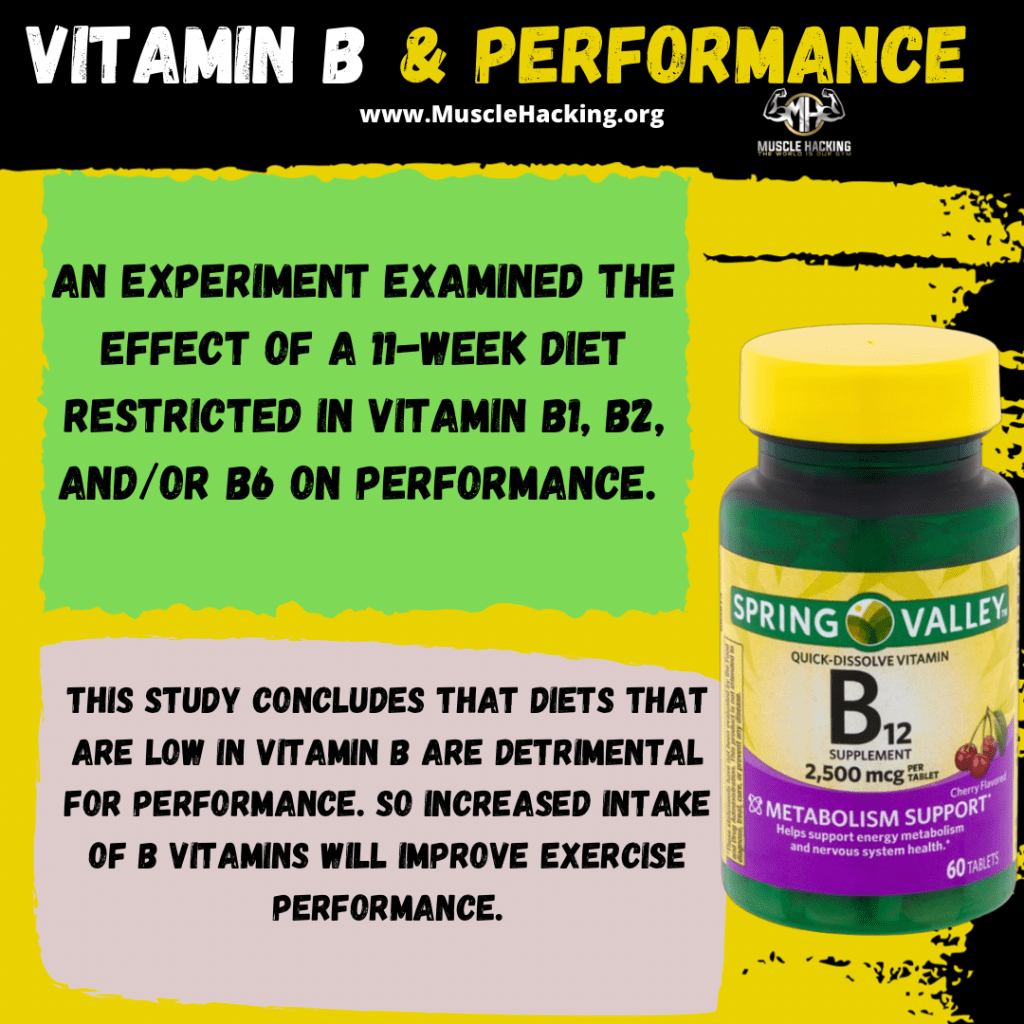
B vitamins play a big part in energy production. Therefore, these vitamins are essential for optimal exercise performance.
An experiment examined the effect of a 11-week diet restricted in vitamin B1, B2, and/or B6 on performance.
24 healthy men were enlisted and consumed normal food products and adequate energy intake. The food was picked so that one or more of the B vitamins were restricted (<55% RDA).The performance of their exercises were measured with a maximal test on a cycle ergometer.
The group that was on a vitamin B restricted diet had a lowered maximal workload and maximal oxygen consumption (VO2max) during the 11-weeks by 6% and 7%, respectively.
This study concludes that diets that are low in vitamin B are detrimental for performance. So increased intake of B vitamins will improve exercise performance.
A strong core can benefit you in various ways, such as preventing injuries, reducing back pain, and stimulating proper posture.
While working out on the core, people often target the rectus abdominis (the six pack) yet leave out the internal and external obliques ( side abs), and the transverse abdominis (underneath the side ab).
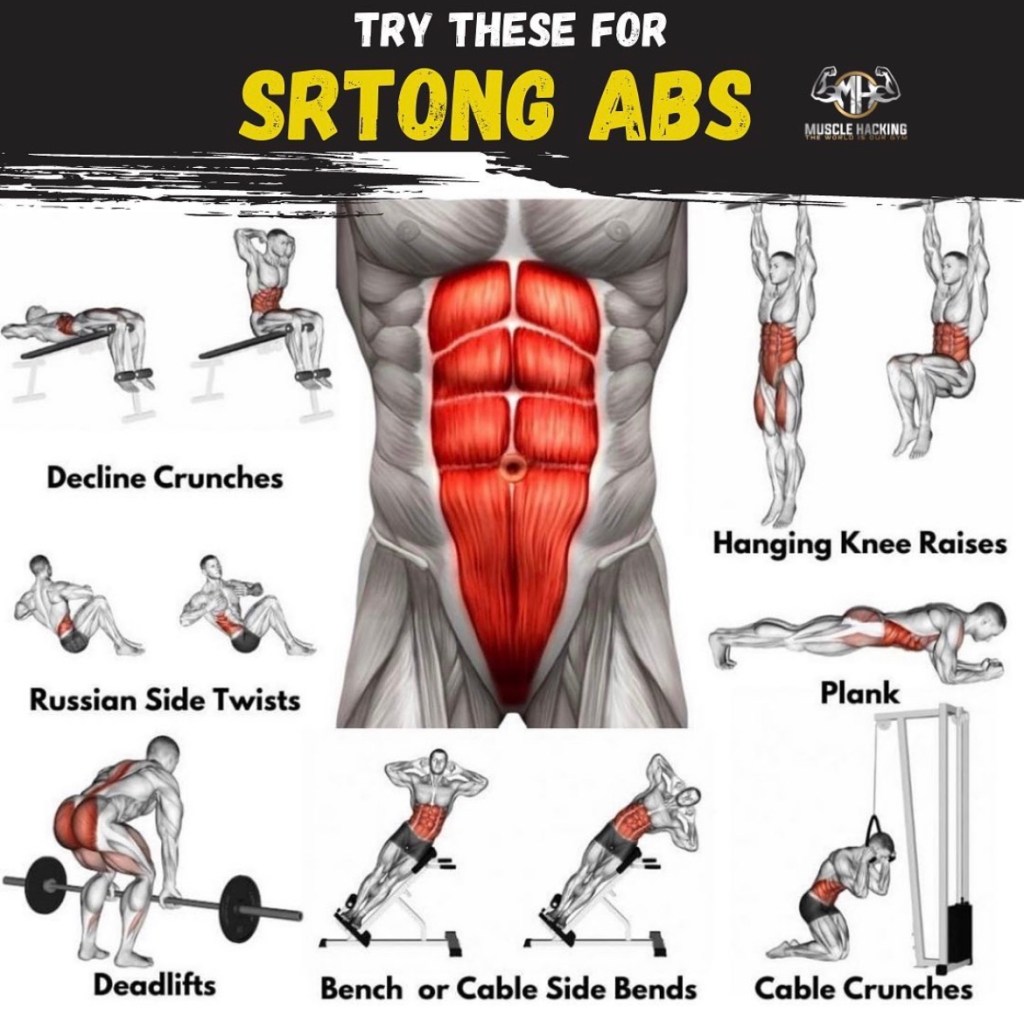
Building a strong core requires more exercises than just crunches.Not to mention, the abdominals have limited and specific movements that consist of different muscles that run through the entire length of the torso. Here are a few core workouts to add to your regimen.
Planks are one of the best exercises for working the core and burning calories. Doing a plank hold will engage multiple muscles at once, while benefiting the core strength of your body.
Decline crunches are great for eliminating the tendency to use momentum to complete the movement. Increase the decline angle over time in order to progressively overload.
The Russian Side Twist targets your obliques. Try adding a dumbbell or medicine ball increases to make this workout more challenging.
Hanging knee raises with a twist can help build muscular stability in the upper back and shoulders. This workout can increase both muscular size and strength.
Cable Crunches enables you to increase resistance, allowing you to train to failure using heavier weights.
Cable Side Bend targets the obliques and improves stability in the lower back.
▪️ I’m sure that you’ve heard the phrases: “eat clean, train dirty” or “eat clean, train mean” or “you can’t expect to look like a million bucks if you eat off the dollar menu.”But what is the true meaning behind these phrases? If you were to ask 10 people what it means to “eat clean,” you’ll get 10 different responses.
▪️These phrase all have one thing in common: it’s exceptionally restrictive. Because of false information, we are often led to believe that some foods are good and other foods are bad. Not one person has ever dropped dead from eating one candy bar though—just like no one has ever woke up in the morning lean and healthy from eating a few servings of vegetables. This is not to say that we should choose chocolate chip cookies over apples and carrots. What I am directing towards is, being too restrictive on a diet is making it nearly impossible to consume the appropriate amount of nutrients that your body needs.
Lose 10 Pounds in 10 Weeks ⠀⠀ Some “fitness professionals” will sell you on the idea that you can easily lose 10 pounds (of body fat) in 10 days, or that there’s a magic 21-day fix program to finally get your best body of your life in record time… ⠀⠀ And sure, while there is, maybe, ehh, a little bit of truth to these claims — if and only if — you restrict your calorie intake to extreme levels (unhealthy), if you overexercise and overtrain (unhealthy and unsafe) and if you sacrifice your ideal lifestyle (incredibly stressful), it’s NOT something I would promote or recommend. Ever. ⠀⠀ The truth is that somewhere between 0.5 pounds and 1.5 pounds per week of weight loss is not only realistic, but also achievable for most people. Could be more, too, depending on circumstances, but generally that’s acceptable. ⠀⠀ This means that in 8-weeks, you can lose between 4 and 12 pounds. ⠀⠀ This means that in 10-weeks, you can lose between 5 and 15 pounds. ⠀⠀ This means that in 12-weeks, you can lose between 6 and 18 pounds. ⠀⠀ And once you understand the expectations, it’s important to implement the plan that can help you get there as smoothly, safely and seamlessly as possible. Here’s an outline of that plan: ⠀⠀ Strength training 3-4x per week (you could do 5x but not required)
Eat in a 500-750 calorie deficit on average
Consume close to 1.0 grams of protein per pound of bodyweight
Drink 2/3 your bodyweight in pounds in ounces of water each day
Aim for 6-8 hours of high quality sleep per night
Some cardio won’t hurt, but don’t overdo it
Patience is key, because fat loss is not linear ⠀⠀
Training Frequency – How Often Should You Train Each Muscle Group? ⠀ These are averages and your specific training frequency will vary depending on your fitness level and experience. ⠀
These training frequencies are for strength and muscle growth. ⠀ Back 2-4 times per week Chest 2-3 times per week Deltoids 2-6 times per week Arms 2-3 times per week Abs 2-3 times per week Quadriceps 2-3 times per week Glutes 2-3 times per week Hamstrings 2-3 times per week ⠀ Keep in mind that the “Deltoids” have up to 6 times per week because you’re usually training your posterior and lateral deltoids (back and side of shoulders) with very low intensity, so they recover somewhat faster than other muscle groups. ⠀ How do you reach this? Doing a Full-Body Workout 3 times per week or Upper/Lower split 4 times per week will hit all these muscle groups about 2-3 times per week. It’s all about how you program your workouts, and everyone has different goals with their training, so pick whatever fits your goals and life.
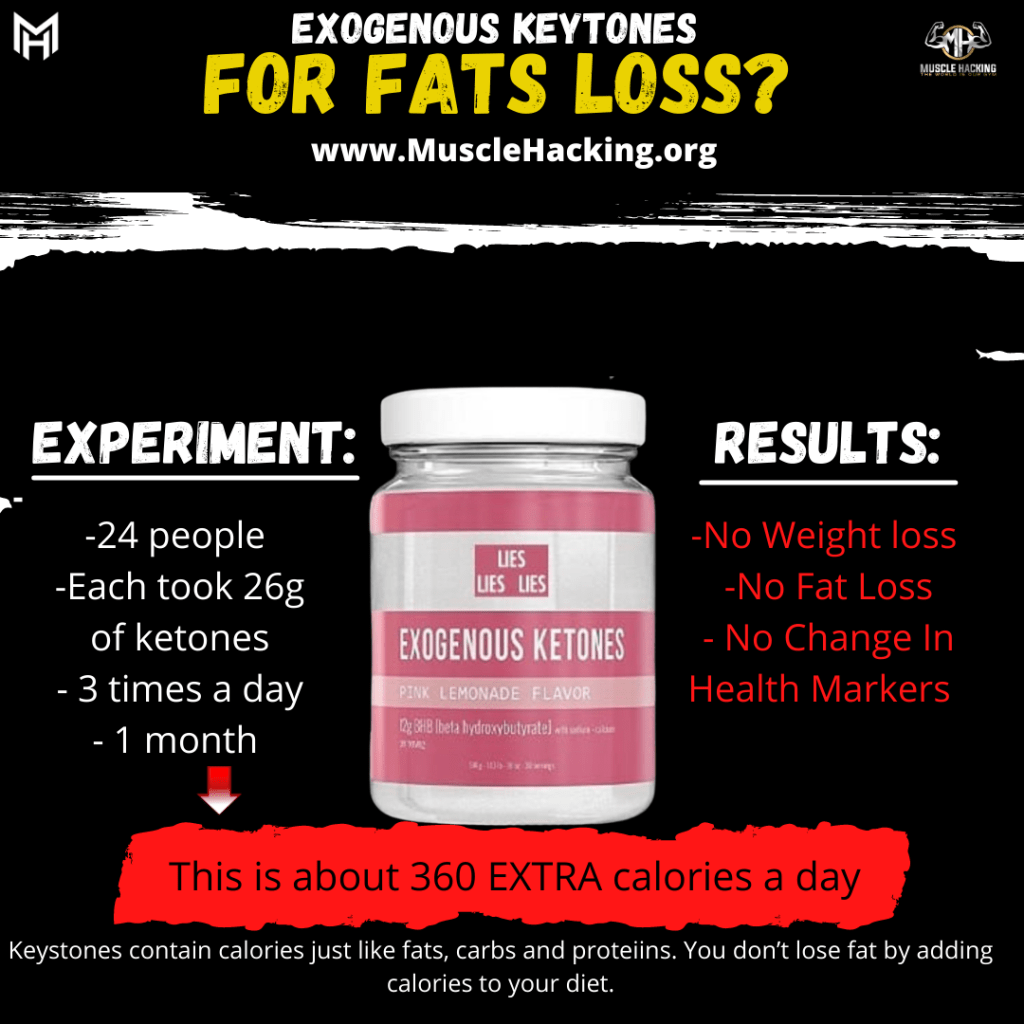
Here’s a very easy explanation why ketone supplements don’t work for fat loss. ⠀⠀⠀⠀⠀⠀⠀⠀⠀ I had to do this post because a number of my PT friends have told me about how popular these supplements are and how many of them have been approached to sell them as weight loss supplements. ⠀⠀⠀⠀⠀⠀⠀⠀⠀ Very low carbohydrate diets cause the body to produce ketones by breaking down fats.
The body can the use the ketones instead of glucose (a carb) which is in short supply.
When the body makes its own ketones, we call this “ketosis” because the levels of ketones in the blood get higher. ⠀⠀⠀⠀⠀⠀⠀⠀⠀ ⚠️HERE’S THE IMPORTANT PART: People will only lose fat on a ketogenic diet if they are eating fewer calories (WHICH IS EXACTLY WHAT HAPPENS IF YOU CUT OUT A FOOD GROUP (CARBS). ⠀⠀⠀⠀⠀⠀⠀⠀⠀ Exogenous Ketones are popular supplements now because they “put you in ketosis”. This isn’t nutritional ketosis from carb and calorie deficit… It’s high blood levels of ketones from taking them directly… It’s kind of like “PRETEND KETOSIS” ⠀⠀⠀⠀⠀⠀⠀⠀⠀ Another thing many don’t realise is that Ketones contain Calories (4 kcal/g just like carbs and protein).
In the study above, the ketones added 360 calories…that’s a small meal. ⠀⠀⠀⠀⠀⠀⠀⠀⠀ THE RESULTS: ❌No weight loss ❌No fat Loss ❌No changes in any health markers (so at least they’re safe) ⠀⠀⠀⠀⠀⠀⠀⠀⠀ Unfortunately the study didn’t provide any information on food intake or activity levels to explain why participants didn’t gain weight. ⠀⠀⠀⠀⠀⠀⠀⠀⠀ Ketone supplements DO NOT HELP FAT LOSS because they skip the calorie reducing effect of ketogenic diets. ⠀⠀⠀⠀⠀⠀⠀⠀⠀ If fat loss is your goal, forget about supplements and focus on a healthy diet and lifestyle changes ⠀⠀⠀⠀⠀⠀⠀⠀⠀ They may have other benefits to ketones potentially but if you buy them for fat loss. Don’t waste your money. ⠀⠀⠀⠀⠀⠀⠀⠀⠀ ⠀⠀⠀⠀⠀⠀⠀⠀⠀ Reference: Soto-Mota et al. (2019). Safety and tolerability of sustained exogenous ketosis using ketone monoester drinks for 28 days in healthy adults
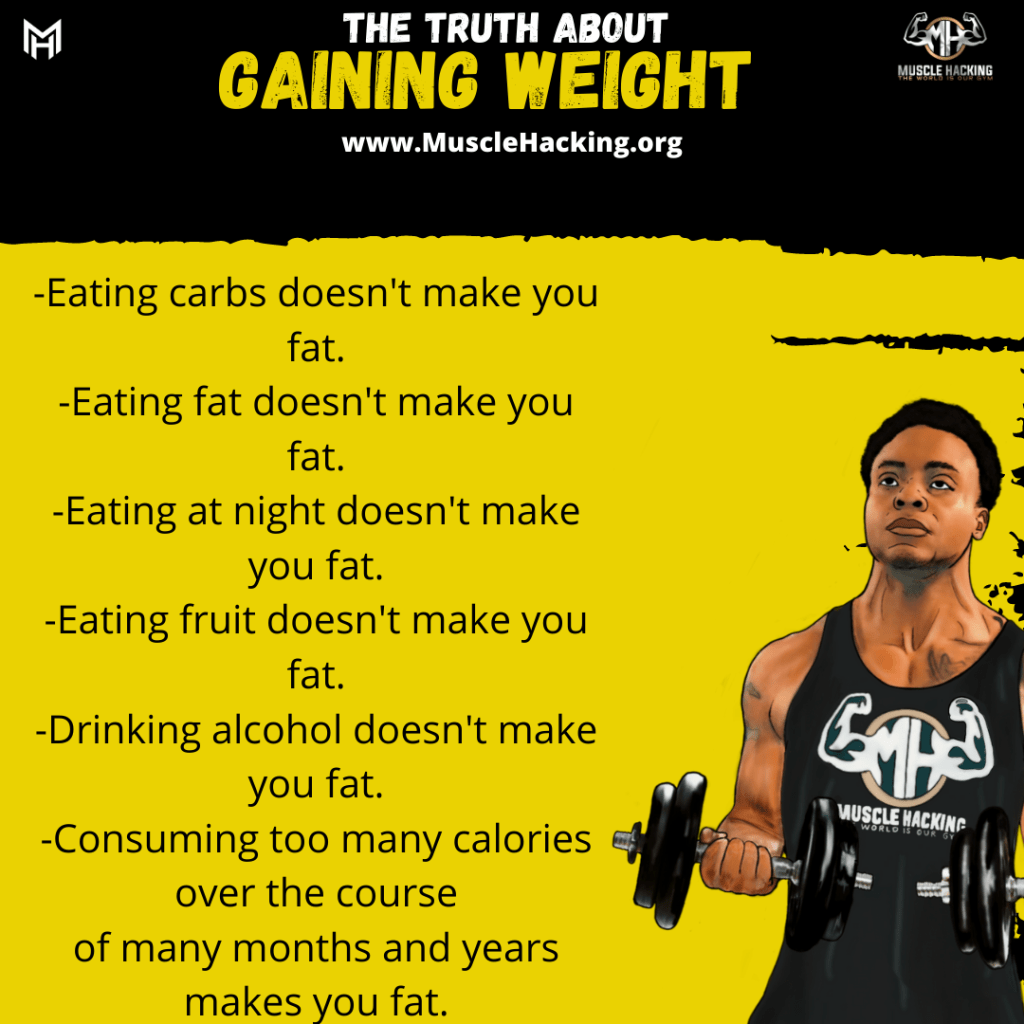
It’s totally normal to want to be able to pinpoint ONE thing and blame it for why we gain fat.
It is rarely even one thing though.
Let’s say you want to lose 15 lbs because you weighed that much 5 years ago and felt more confident, more energetic and happier at that weight
You probably gained those 15 lbs gradually over the course of 5 years because you were consistently in a slight calorie surplus
Not because of carbs
Not because you ate at night
You can lose that weight without restricting anything. You just need to have a plan to stay in a caloric deficit and give your plan time to do its work!
Cutting out carbs, alcohol, fruit or whatever will NOT be the long term solution you are looking for. Sure, you might drop 5 lbs but then you’ll probably gain it back and be back at the drawing board looking for another food group to blame
Skip that cycle and choose a sustainable plan that you can see yourself happily sticking to for the REST OF YOUR LIFE





 musclehacking.org